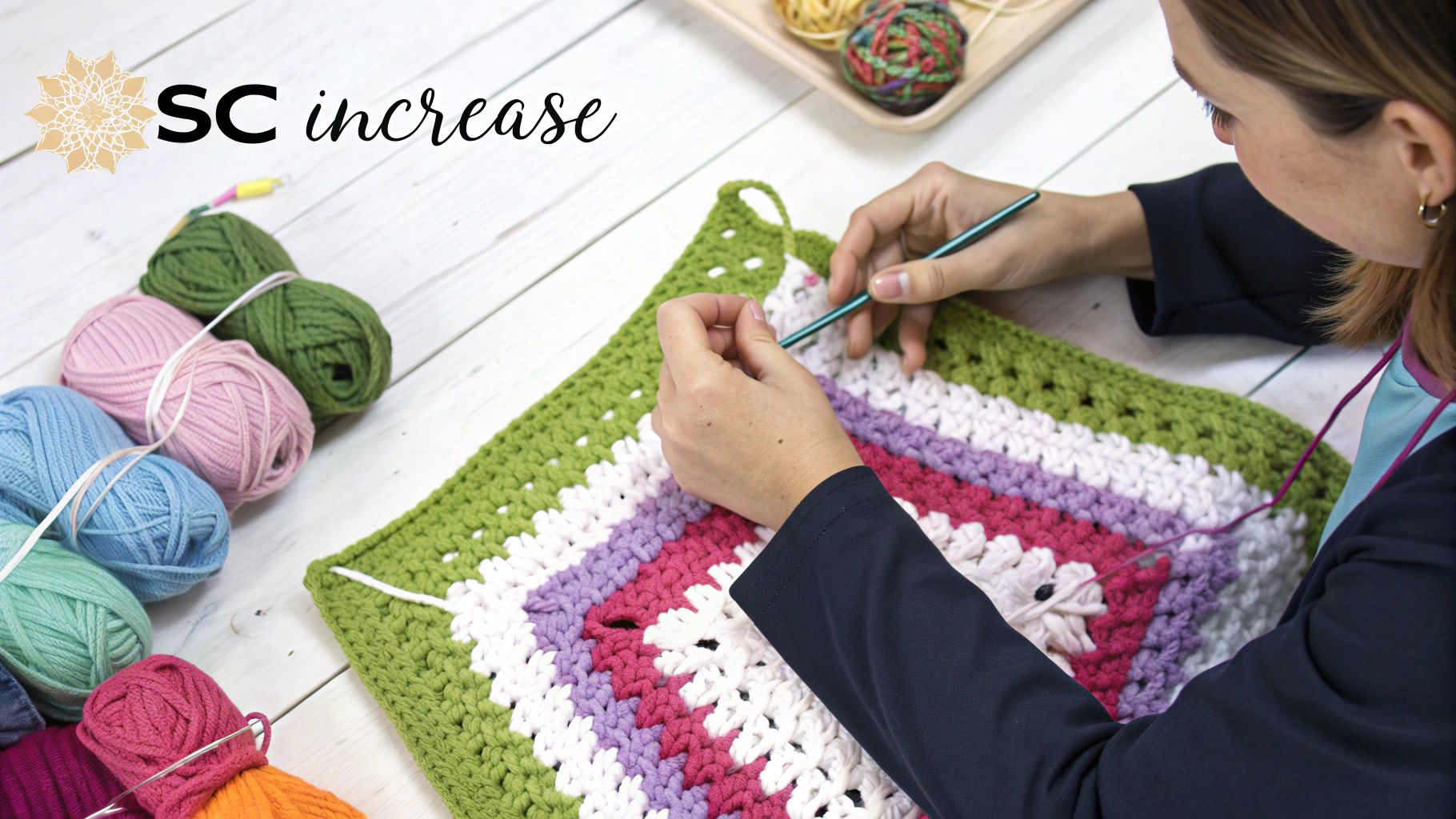
Welcome to the stitch that brings crochet projects to life! The single crochet increase, often written as sc inc crochet or simply inc, is the act of working two single crochet stitches into the very same spot. This one simple move is the secret behind creating curves, shaping amigurumi, and making perfect flat circles that don't curl up at the edges.
Ready to unlock a new level of creativity? Let's get started.
Why the INC Is Your Most Important Crochet Stitch
The inc crochet stitch is how a flat spiral transforms into the sweet little head of an amigurumi animal or the crown of a perfectly fitted hat. It’s a core skill that opens up a world of three-dimensional creativity, building your confidence one project at a time. Think of it as the key that opens the door to countless patterns and beautiful new shapes.
Your Gateway to Shaping
Without the ability to increase, every project would be a straight line or a simple rectangle. The inc is what allows you to add width and volume exactly where you need it. For many of us, learning how to control this stitch is the moment crochet finally "clicks."
You might be surprised how many projects lean on this fundamental skill. While the single crochet is often the first stitch you learn, it's the increase that lets you customize and create true form. You can explore all sorts of crochet trends and see just how central these basics really are.
Actionable Tip: Grab a scrap piece of yarn and a hook. Make a small chain and a row of 10 single crochet stitches. On the next row, try placing an increase in the very first and very last stitch. See how it starts to flare out? That's shaping in action!
Building Foundational Confidence
Getting this one technique down provides an incredible confidence boost. Once you truly understand how and why an increase works, you’ll start seeing its magic everywhere in different patterns.
This new understanding makes complex-looking patterns feel much less intimidating and gives you the freedom to start experimenting on your own. Each successful increase is a small win that makes you feel more capable and creative, turning a simple hobby into a truly joyful practice.
Making Your First Increase
Ready to give it a try? The inc crochet stitch feels almost exactly like making two regular single crochet stitches. The only trick is that they both go into the same spot. Let's forget about rigid steps for a moment and focus on the flow of the movement. This is all about building muscle memory.
The magic happens right after you complete your first single crochet. Instead of moving on to the next stitch in the row like you normally would, you’re going to pause and re-insert your hook into the very same stitch you just worked. It’s like giving that stitch a little friend to help your fabric grow.
The Two-Stitch Rhythm
To get started, you’ll want to be comfortable with the basic single crochet. If you need a quick refresher, feel free to check out our simple guide on how to do a single crochet stitch. Once you’ve got that down, the increase will feel like a natural next step.
Your main goal is to make both stitches look like identical twins. The key to this is maintaining even tension, the amount of pull you keep on your yarn. If you pull too tightly on that second stitch, it can look smaller and might even create a little gap. A relaxed, consistent hand motion is what you're aiming for. Matching your yarn, hook, and tension creates the perfect trio for smooth, predictable stitches every time.
The Single Crochet Increase at a Glance
Sometimes a quick reference is all you need to lock in a new skill. Use this table to remember the core actions and tips for a perfect sc inc.
|
Action |
Visual Cue |
Pro Tip for Beginners |
|---|---|---|
|
Work 1st SC |
Insert hook under the 'V', complete one single crochet. |
Make this first stitch just like any other. Don't overtighten it. |
|
Re-insert Hook |
Find the same 'V' you just worked into. |
Your hook should go back into the exact same hole. No new stitches yet! |
|
Work 2nd SC |
Complete a second single crochet in that same spot. |
Try to match the tension of the first stitch for a clean, even look. |
|
Check Your Work |
Look for 2 distinct 'V' shapes coming from one stitch below. |
This confirms you’ve successfully added a stitch to your row. |
This little cheat sheet is great for keeping beside you as you practice. Before you know it, you won't even need to think about it!
Identifying the Right Stitch
Let's talk about where exactly to put your hook. When you look down at the top of your work, you’ll see a series of "V" shapes. Each "V" is a single stitch. For a single crochet increase, you'll be inserting your hook under both loops of the "V" your pattern calls for.
After you make that first single crochet, your muscle memory might scream at you to move to the next "V." Gently resist! Guide your hook right back into that same opening. This simple repetition is the whole secret to the inc crochet technique.
Take a deep breath and let the motion feel easy. Crafting is a journey, not a race. Each stitch is a small moment of mindfulness, and building this new skill should feel restorative and fun.
Remember, the goal isn't perfection on your first attempt. It’s about giving yourself the space to learn and enjoying the process. Every crafter started exactly where you are now, turning a new skill into second nature, one stitch at a time.
Choosing Your Tools for Successful Practice
Having the right tools can turn practice from a chore into a moment of pure joy. Just like a painter chooses their favorite brushes, selecting the right yarn and hook for your sc inc crochet practice can make all the difference. It helps you see your stitches clearly and feel proud of your progress.
It's no surprise that so many people are discovering the happiness that comes from creating with their own hands. This shared passion for crafting helps build communities and connects us in wonderful ways.
Finding Your Perfect Yarn
Choosing yarn isn’t about finding the single “best” one, but the best one for you and what you're making. Every fiber has its own personality and purpose. Here are a few great options:
Mercerized Cotton (Fingering Weight): Smooth, durable, with crisp stitch definition. It holds its shape well, making it ideal for amigurumi or projects with fine detail.
Cotton Blends (DK/Worsted Weight): Breathable and easy to care for, these are a great choice for summer garments, dishcloths, and other homewares.
Acrylic (Worsted Weight): A budget-friendly and machine-washable option, common for blankets and everyday projects.
Wool/Wool Blends: Warm and elastic with great stitch recovery. Perfect for cozy hats and sweaters, but always check the care instructions and consider skin sensitivity.
Our Gentle Guidance: When you're first learning the inc crochet stitch, especially for amigurumi, we recommend starting with a light-colored mercerized cotton yarn. The smooth fibers won’t split easily, and the light color makes it so much easier to see exactly where to place your hook.
The Right Hook for Comfortable Crafting
Your crochet hook is your main tool, so comfort is key! A hook that feels good in your hand can prevent cramping and allow you to crochet for longer, turning your practice into a relaxing, mindful escape. Ergonomic hooks with soft-grip handles are a game-changer for this.
The hook size should always match your yarn weight to create an even, consistent fabric. If you’re ever unsure, the yarn label almost always suggests a recommended hook size. For more detailed advice, you can check out our beginner's guide to buying crochet hooks.
Solving Common Increase Stitch Problems
Every single crafter, from a total beginner to a seasoned pro, has moments where their stitches just won't cooperate. It's a completely normal part of the learning curve! Try to think of these little hiccups not as failures, but as your yarn teaching you something new about this beautiful craft. Let’s gently untangle some common issues with the inc crochet stitch.
Sometimes you might spot a small but stubborn hole right where you made your increase. This usually happens when you pull the yarn just a tad too tight on that second stitch, which stretches out the stitch below it. It’s a classic tension issue, and honestly, it’s one of the most common hurdles for new crocheters. Taking a deep breath and consciously relaxing your hands can make a world of difference.
A Gentle Reminder: Your crochet should feel fluid, not forced. If your hands are cramping or your hook is squeaking against the yarn, that's your cue to loosen up and let the yarn glide.
Keeping Your Shapes and Counts Correct
Have you ever worked on a perfect circle, only to find it's starting to look more like a hexagon? Or maybe you've finished a round and realized your stitch count is off again? Trust me, you are not alone! These are classic signs that your increases need a little attention.
-
Lopsided Shapes: This is a clear sign that your increases aren't spaced evenly. If a pattern says to repeat
(2 sc, inc) x 6, it’s really important to follow that sequence precisely all the way around. Placing increases randomly will pull the fabric into an uneven shape every time. - Lost Stitch Count: When you're working in continuous rounds, especially with amigurumi, it is incredibly easy to lose your place. Just one missed or extra increase can throw off the entire project. This is where a simple tool becomes your absolute best friend.
A stitch marker is a must-have for working in the round. Place it in the first stitch of every new round without fail. When you crochet all the way back to that little marker, you know the round is complete. This tiny helper removes all the guesswork and lets you get back to the relaxing, mindful rhythm of your stitches.
Addressing Tension Troubles
Tension is the secret sauce for creating smooth, even fabric. If your stitches feel super tight one moment and loose the next, it’s going to show in your increases. Finding your personal rhythm just takes time and practice, so be kind to yourself.
If you feel like you're constantly fighting your yarn, our guide on understanding your crochet tension offers some gentle tips to help you find a comfortable flow. Remember, every stitch you make is building muscle memory and bringing you one step closer to the confident crafter you’re becoming.
Simple Projects to Practice Your New Skill
Now for the best part: putting your new sc inc crochet skill to work! There's no better way to build confidence than by making something you can hold and use, no matter how small. Starting with quick, achievable projects gives you that instant sense of accomplishment and really helps lock in the muscle memory.
Think of these as fun little practice drills that result in charming handmade items. They're the perfect way to see how your stitches come together to create actual shapes.
Start with a Simple Circle
One of the absolute best ways to practice the increase is by making a flat circle. It’s the starting point for so many patterns, from amigurumi heads and coasters to the crown of a hat. You’ll get to see the magic of the inc crochet stitch firsthand as you work in the round.
As you place your increases evenly, you'll see how they prevent the fabric from curling up into a bowl. A simple coaster is a fantastic first project. It works up fast, and you’re left with a beautiful, functional piece to admire when you’re done.
Other Beginner-Friendly Ideas
Once you've got the hang of a flat circle, you can move on to other simple shapes that continue to build on what you've learned. Each one teaches you something a little different about how increases function.
A Basic Amigurumi Ball: This is the natural next step from a flat circle. You'll use increases to shape the top half and then learn decreases to close it up, creating a perfect little sphere. It's the foundation of almost every cute creature you can imagine.
A Center-Out Dishcloth: For this, you’ll start with a magic ring and place increases at four corners on each round. This technique creates a square that grows outward and is a great way to practice placing your increases more strategically.
This is a really exciting time to be learning this craft. The love for handmade goods is fueling a surge in popularity and connecting crafters all over the world.
Answering Your Top INC Questions
As you get more comfortable with the single crochet increase, a few questions almost always pop up. Let's tackle them so you can keep crocheting with confidence.
How Do I Know Where to Place My Increases?
Thankfully, you don't have to guess! Nearly every pattern will tell you exactly where the increases go.
For projects worked in the round, like our amigurumi dolls, increases are spaced out evenly to get that perfect flat circle or gentle curve. A pattern might say something like [sc, inc], which just means you'll work one single crochet in one stitch, then an increase in the very next stitch. You'll repeat that little sequence all the way around.
Help! My Circle Looks More Like a Hexagon!
Don't panic, this is one of the most common hurdles for crocheters. It happens when your increases from each round stack directly on top of one another, creating subtle "corners."
The fix is surprisingly simple: stagger your increases. For example, if one round calls for [4 sc, inc], you could start the next round with 2 sc, inc. After that, you'd just continue with the regular [4 sc, inc] pattern until you finish the round. This little trick breaks up the alignment and smooths those corners right out, giving you a much rounder shape.
The concept of an increase (working two stitches into one) applies to nearly any stitch. You can create a half double crochet increase (inchdc) or a double crochet increase (incdc) the exact same way. The sc inc crochet stitch is just the most common for amigurumi because it creates a wonderfully dense and sturdy fabric with no gaps.
With each stitch, you're not just making a project; you're creating a moment of calm and joy for yourself. Be patient, enjoy the process, and celebrate your progress. You've got this!