

So, you’re ready to learn how to crochet? It all starts with a simple ball of yarn and the right hook. Once you learn how to hold them comfortably, you'll practice two foundational skills: the slip knot and the chain stitch. From there, you're just a few steps away from your first real stitch and creating something wonderful. You've got this!
Your First Steps Into the World of Crochet
Welcome to the wonderfully creative and relaxing world of crochet! If you've ever admired a handmade doll or a cozy blanket and thought, "I wish I could do that," you're in exactly the right place. Think of this guide as your friendly starting point, designed to turn any hesitation into pure excitement and confidence. We’re here to show you that anyone, including you, can pick up a hook and yarn and make something beautiful.
Forget the idea that crochet is too complicated for a beginner. We're going to focus on the simple, rewarding steps that get you started, especially if you dream of making those charming amigurumi figures you've seen online.
A New Creative Outlet
Learning to crochet is about so much more than just making things. It's about discovering a new way to unwind and let your creativity flow. Many people find the rhythmic, repetitive motions of stitching to be incredibly calming, making it the perfect activity to de-stress after a long day. It’s a craft that offers both a peaceful escape and a real, tangible sense of accomplishment.
Crochet is a skill that stays with you for life. Once you master the basics, a whole world of creative possibilities opens up, from adorable dolls, like the ones we make at Crochetree, to stylish home decor. That entire journey begins with your very first stitch.
What You Can Expect to Learn
We've structured this guide to build your skills logically, without that overwhelming feeling of "where do I even start?" We'll walk you through everything you need to know, making sure you feel supported from the get-go.
Here’s a peek at what’s ahead:
Gathering Your Tools: We'll introduce the essential supplies and explain why we recommend a smooth, fingering weight, 100% mercerized cotton yarn. This type of yarn is fantastic for making crisp, defined stitches, absolutely perfect for amigurumi.
Mastering the Basics: You’ll learn the fundamental movements, from making a slip knot to creating your first single crochet stitch. These are the building blocks for everything else.
Building Confidence: We’ll share tips to help you overcome common beginner hurdles, turning those inevitable first mistakes into valuable learning moments.
Many aspects of learning a new needlecraft are universal. For instance, exploring a beginner's guide to cross-stitch can offer a fresh perspective on starting a crafting journey. The core principles of patience, practice, and learning to read patterns are skills that will serve you well, no matter which craft you choose.
Choosing Your Essential Crochet Supplies
Before you can even think about making your first stitch, you'll need to gather a few key tools. I know, walking into a craft store can feel like stepping into a yarn tornado, so many options, where do you even begin? But for amigurumi, you really only need a simple, curated kit to get started.
Getting the right supplies makes the whole learning process smoother and way more fun. It really does set you up for success right from the get-go.
Think of your first yarn and hook like dance partners. When they click, everything just flows. If they don't, you'll feel like you're constantly tripping over your own feet. That’s exactly why I'm so passionate about helping new crocheters pick the absolute best tools for the job.
Why Your First Yarn Matters Most
For amigurumi, the yarn you choose has a massive impact on your final creation. Trust me on this one: start with 100% mercerized cotton yarn in a fingering weight. This specific type of yarn is a total game-changer for anyone just learning the ropes. Once you’re comfortable, you can also explore cotton-acrylic blends for a softer feel, acrylic yarns for budget-friendly practice, or plush chenille yarns for creating cuddly, huggable toys. Each yarn gives your dolls a different personality, so part of the fun is experimenting to see which look and feel you love most.
The term "mercerized" refers to a treatment process that makes cotton fibers stronger, smoother, and gives them a beautiful, subtle sheen. This process is key to preventing the yarn from splitting while you work.
The mercerized cotton is a lifesaver for a beginner. Your hook will glide through the stitches without catching on pesky loose fibers. The result? Clean, defined stitches that make your work look polished right away, which is a fantastic confidence booster!
The smooth texture is also just plain comfortable to work with, which helps keep frustration at bay. And if you're making items that will be handled a lot or given to little ones, it's always a good idea to learn how to choose the best yarns for sensitive skin to make sure everything is cozy and safe.
Picking the Perfect Crochet Hook
Your crochet hook is going to become an extension of your hand pretty quickly, so comfort is everything. Hooks come in all sorts of materials, aluminum, bamboo, plastic, and many now have cushy ergonomic handles.
For the fingering weight yarn we recommend, a hook size between 2.0mm and 2.5mm is the sweet spot.
The goal with amigurumi is to create tight, dense stitches so the stuffing doesn’t peek through. A smaller hook is your secret weapon for achieving this. If you want to dive deeper into finding your perfect first tool, our beginner's guide to buying crochet hooks has all the details on what to look for.
Other Must-Have Tools for Your Kit
Beyond yarn and a hook, a few other small tools will make your crochet journey so much easier. Think of these as your essential support crew.
To make things simple, here’s a quick checklist of everything you’ll want in your starter kit.
Your Beginner Amigurumi Crochet Toolkit
|
Tool or Material |
Recommended Specification |
Why It's Essential for Beginners |
|---|---|---|
|
Yarn |
100% Mercerized Cotton (Fingering Weight) |
Smooth, non-splitting, and creates crisp stitches perfect for small toys. |
|
Crochet Hook |
2.0mm - 2.5mm Ergonomic Hook |
Creates tight stitches to hide stuffing and is comfortable for long sessions. |
|
Stitch Markers |
Latching Plastic Markers |
Absolutely crucial for tracking rounds in amigurumi so you don't lose your place. |
|
Yarn Needle |
Blunt-tipped with a large eye |
Needed for weaving in ends and seamlessly sewing parts of your project together. |
|
Scissors |
Small, sharp craft scissors |
Provides clean cuts without fraying the yarn, keeping your work neat. |
Having these items on hand from day one will help you focus on mastering the stitches, not fumbling for the right tool.
Stitch Markers: These little clips are your new best friends. Since amigurumi is mostly worked in a continuous spiral, these markers are the best way to know where one round ends and the next begins. They're a must for accurate stitch counts. Alternatively, you can use a contrasting strand of yarn, but stitch markers are often essential for marking specific points in your project, so it’s best to keep a few on hand.
Yarn Needle: Sometimes called a tapestry needle, this is a blunt-tipped needle with a big eye. You’ll use it constantly for weaving in ends and sewing your amigurumi pieces together.
Sharp Scissors: A small, sharp pair of scissors is non-negotiable for cutting your yarn cleanly. Any pair will do in a pinch, but a dedicated pair of craft scissors is a great little investment for your toolkit.
Mastering the Fundamental Stitches and Techniques
Alright, this is where the real fun begins. Let's get one thing straight: crochet is not nearly as complicated as it looks. We're going to break down the core techniques into simple, repeatable motions that will feel like second nature in no time.
Think of it like learning to ride a bike. You’ll be a little wobbly at first, sure, but soon enough, you'll be cruising without even thinking about it. Every single adorable amigurumi creature starts with these exact same skills. Your goal right now isn’t perfection, it’s just progress. Be patient with yourself, and remember that every expert started right where you are now.
Your First Stitches: The Slip Knot and Chain
Before you can make anything, you have to get the yarn on your hook. That's where the slip knot comes in. It’s just a simple, adjustable loop that kicks off almost every crochet project. Once you nail this, you’re ready to make a foundation chain.
A chain is just a series of interconnected loops that looks like a tiny braid. It forms the base for a lot of projects. While you'll often start amigurumi with a different method (like a magic ring, which we’ll get to), practicing chains is the absolute best way to build muscle memory.
The Mighty Single Crochet Stitch
Now for the main event: the single crochet stitch (usually shortened to 'sc'). This humble stitch is the absolute workhorse of amigurumi. It’s what creates that tight, dense fabric perfect for sculpting shapes and making sure none of the stuffing peeks through.
Honestly, learning this one stitch is like getting the key to the kingdom. Almost every other technique, like making your shapes bigger or smaller, is just a simple twist on this single motion. If you want a closer look, you can explore the mechanics of basic crochet stitches in our guide for some step-by-step tutorials.
By picking up this hook, you’re joining a massive community. The global knitting and crochet market is set to grow by an incredible USD 12.28 billion between 2024 and 2029. That growth is powered by people just like you, discovering the joy of making things with their hands.
Practice Makes Progress
Your only job right now is to practice these basic movements. Don't even worry about making a "thing" just yet. Focus on getting a feel for the rhythm and making your stitches look consistent.
The biggest hurdle for beginners is usually tension, how tightly or loosely you hold your yarn. Getting your tension even is what makes your final project look polished and clean. It’s a skill that only comes with practice, so don't stress if it feels awkward at first.
Here are a few actionable tips you can try right now to build your confidence and muscle memory:
Make practice swatches: Grab your hook and yarn, and just crochet a small square using only single crochet stitches. This lets you focus entirely on the motion without the pressure of a pattern. Try making a few, you'll see improvement from one to the next!
Don't strangle your yarn: A classic beginner move is yanking the yarn tight after every stitch. Keep your loops relaxed enough that your hook can glide through them easily. A good rule of thumb is that the loop on your hook should be about the same size as the shaft of the hook.
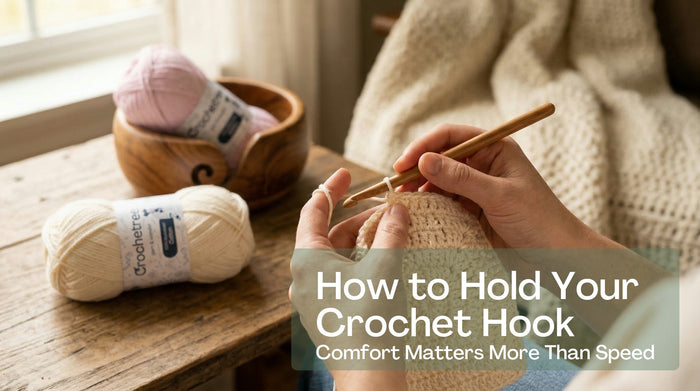
Find your grip: Play around with how you hold your hook and yarn. There’s no single "correct" way. Do what feels natural and gives you the best control. Try the pencil grip or the knife grip and see which feels less clumsy.
Your hands are learning a whole new language. Give them the time and repetition they need to become fluent. Before you know it, you won’t even have to think about it.
How to Read Your First Crochet Pattern
Staring at a crochet pattern for the first time can feel like you’re trying to decipher a secret language. It’s just a page of weird abbreviations and numbers that looks totally intimidating, but I promise, it’s a language you’ll pick up fast. Think of this as your personal codebreaker guide.
A pattern is really just a set of instructions written in shorthand to save space. Once you get the hang of a few key terms, you’ll be able to follow along without a problem. And the best part? Almost every pattern uses a similar structure, so learning this skill now unlocks a whole world of projects.
Learning to read patterns is what empowers you to create anything you can dream up, from cute amigurumi animals to cozy blankets. It’s your ticket into a massive global community of creators, especially with online platforms making it easier than ever to find patterns and connect with other crocheters.
Translating the Crochet Language
First things first, let's get you familiar with the common abbreviations. For amigurumi projects, you'll see the same handful of terms pop up over and over again. You don't need to memorize a whole dictionary, just focus on these essentials for now.
Here are the heavy hitters you’ll see right away:
sc: This stands for single crochet. It’s the main stitch you've been practicing and the absolute foundation of almost all amigurumi.
inc: This means increase. You'll work two single crochet stitches into the same stitch from the round below. This is how you make your project get wider.
dec: This means decrease. You'll work two stitches together to become one, making your project narrower. It's essential for creating shapes and curves.
MR: This stands for Magic Ring (or Magic Circle). It’s that special technique for starting projects in the round without leaving a hole in the middle.
Don't panic about remembering all of this at once. Most patterns include a key that lists all the abbreviations they use, so you'll always have a handy reference right there. For a much deeper dive, you might want to check out our guide on mastering the art of reading crochet patterns.
Understanding Pattern Structure
Amigurumi is almost always worked in a spiral, meaning you just keep going round and round. Because of this, your pattern will be broken down by round, usually labeled something like R1, R2, R3 (or Rnd 1, Rnd 2, Rnd 3), and so on. Each line tells you exactly what to do for that specific round.
Key Takeaway: The number in parentheses at the end of each round is the total stitch count for that round. This is your best friend for checking your work and catching any mistakes before they become a big deal.
This guide focuses on teaching you the foundational skills of crochet, rather than providing specific project patterns. By mastering these core techniques, understanding the stitches and learning how to read any pattern, you are empowering yourself to create anything you can imagine. Our goal is to equip you with the knowledge that unlocks a universe of creative possibilities, so you can confidently tackle any amigurumi project that inspires you.
Navigating Common Beginner Challenges
Let's be real: making mistakes is just part of learning how to crochet. Every single person who has ever picked up a hook has been exactly where you are right now, staring at a wonky-looking swatch and wondering what on earth went wrong. It happens!
So, let's talk about the most common beginner hurdles and how to jump over them. This is all about learning how to troubleshoot your own work, turning those "argh!" moments into genuine lessons that will make you a better, more confident crocheter. Trust me, every mistake is a learning opportunity in disguise.
The Great Tension Struggle
One of the very first things you'll grapple with is tension. It's just a fancy word for how tightly or loosely you hold the yarn as you work. If your tension is all over the place, your project might look wavy, feel stiff as a board, or have noticeable gaps between the stitches.
If your stitches are so tight you can barely jam your hook into them, you're holding on for dear life. Try to relax your hand and let the yarn glide more smoothly through your fingers. But if your stitches are loose and sloppy, you’ll want to gently guide the yarn to create tighter, more uniform loops on your hook.
It’s all about muscle memory. Your hands are learning a brand new dance, so be patient with them. The more you crochet, the more your tension will even out naturally without you even having to think about it.
The Mystery of the Missing Stitches
Oh, the dreaded miscount. This happens to everyone, especially when you're working in a continuous spiral for amigurumi. You get into a nice rhythm, you're cruising along, and then you look down and have absolutely no idea where your round started or ended.
This is where stitch markers become your best friend. Seriously, they're non-negotiable.
Pop a stitch marker into the very first (or the very last) stitch of every single round. When you crochet all the way around and see that marker again, you know you've finished one full round. This tiny habit will save you from an unbelievable amount of frustration and endless recounting.
If you forget, you'll almost certainly end up adding or skipping stitches by accident, which completely throws off the shape of your work. If you realize your count is off, the best thing to do is "frog" it (rip-it, rip-it!) back to the start of the round and do it over. It feels like a setback, but it prevents a much bigger headache later on.
Simple Fixes for Common Goofs
You're going to make mistakes. It's guaranteed, and it's perfectly okay. Learning how to spot them and fix them is what separates the beginners from the pros.
Here’s how to handle a few of the most frequent slip-ups:
Accidentally Added a Stitch? This usually happens when you work two stitches into the same spot by mistake (an accidental increase). The fix is easy: just pull out your hook and gently tug on the yarn to undo the stitches until you get back to the error. Then, just redo it correctly.
Skipped a Stitch? If you miss a stitch, you’ll see a little hole and your count will be off. Just like before, the simplest solution is to frog back to that point and make sure you work into every single stitch like the pattern says.
Is Your Yarn Splitting? If your hook keeps getting tangled between the individual strands of your yarn, you might be inserting it at a weird angle. This is where your choice of yarn is critical. Using a high-quality 100% mercerized cotton yarn is the best way to prevent this. Its smooth, tightly wound fibers are much less likely to split, ensuring a frustration-free experience and clean-looking stitches.
Embrace these little challenges. Every mistake you fix builds your skill and gives you a deeper understanding of how the stitches all work together to create fabric.
A Few Common Questions When You're Learning to Crochet
Jumping into a new hobby always brings up a few questions. Trust me, it's completely normal to wonder about the little details as you figure this all out. We've gathered some of the most common things beginners ask to give you clear, encouraging answers and keep you moving forward with confidence.
How Long Does It Take to Learn Crochet?
This is the big one, and the honest answer is: it’s different for everyone!
Most people can get the hang of a single crochet stitch within a few hours of dedicated practice. You might even have a small, slightly wobbly square by the end of your first day. Feeling really confident, though? That might take a few weeks of consistent practice.
The key is to focus on progress, not perfection. Celebrate the small wins, like finally mastering the slip knot or getting your tension to feel a little more even. Remember, every single stitch you make is building valuable muscle memory.
Is My Hand Supposed to Hurt This Much?
Oh, absolutely. It's incredibly common to feel some cramping in your hands and wrists when you first start! You’re asking your muscles to make new, repetitive motions they just aren't used to yet. Think of it like the soreness you feel after trying a new workout at the gym.
To help with this, take breaks, and take them often. I suggest setting a timer for every 15-20 minutes to stop and stretch your fingers, wrists, and even your shoulders. Over time, your muscles will adapt, and you'll be able to crochet for much longer, pain-free.
Why Does My First Project Look So Messy?
First off, welcome to the club! If your first few attempts look a bit wonky, you’re doing it right. Uneven stitches, accidental holes, and lopsided shapes are practically a rite of passage for every crocheter.
The usual culprits are inconsistent tension (holding the yarn too tight or too loose) and miscounting your stitches. It happens to all of us.
For now, just focus on making your stitches look as uniform as you can. And use stitch markers like they're your best friend, they are a lifesaver for keeping your counts accurate. Using a smooth, high-quality cotton yarn also makes a huge difference. It provides excellent stitch definition and won't split, which helps your work look cleaner right from the start.
This craft has seen a huge surge in popularity recently, especially after the global pandemic accelerated interest in hands-on hobbies. This boom is forecasted to grow the knitting and crochet market to USD 0.29 billion by 2032, all thanks to new crafters like you finding joy in making something by hand. Learn more about the growth of the crafting market.
Ready to finally start your creative journey? Explore our beautiful patterns and get the yarn you need to bring your first project to life! Start your crochet adventure with Crochetree today!
![The Ultimate Beginner's Guide to Crochet [2026]](http://crochetree.com/cdn/shop/articles/feat-ultimate-beginners-guide-to-crochet_eae81cec-84d0-455d-b190-08cd22d826c4.jpg?v=1777713815&width=700)
