Jean Kenwright had been a crafter all her life and a knitter for years. Crochet was the one thing she could not get. That is exactly why she wanted it. She learned from internet tutorials, and it did not take long before she was, in her own word, addicted. Here is her story.
The Skill That Would Not Come
Jean did not come to crochet as a beginner crafter. She already knew how to make things, and she had knitted for years. Crochet was simply the skill that would not click, and being unable to do it was reason enough to go after it.
She learned from online tutorials. Once it finally landed, the addiction set in fast.
A Throw, a Cushion, and a Great Deal of Pride
Her first project was a throw and a matching cushion for her mother in law. It was not perfect. Jean is straightforward about that. She was very proud of it anyway, and the sense of achievement was enormous.
That mix of honesty and pride runs through everything she says about her work. She has now been crocheting for three years.
Falling in Love With Hazel
Jean discovered Crochetree about two years ago and fell for Hazel immediately. She wanted a challenge. It still took her a while to work up the courage to start.
The doll looked complicated, and the hair especially so. That was the part she worried about most.

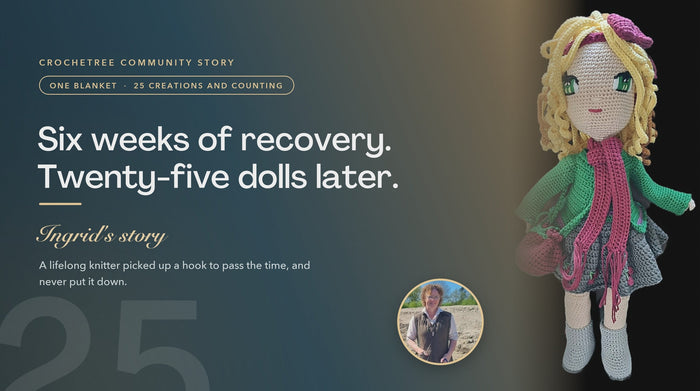
She need not have worried. The pattern was nothing like as complicated as she had first thought. She made a few mistakes along the way and finished anyway, and completing that first Crochetree doll gave her a sense of achievement and pride she still points to when asked for her favorite crochet memory. There are too many good moments to choose from, she says, but if she had to pick one, it would be Hazel.
Three Dolls and Counting
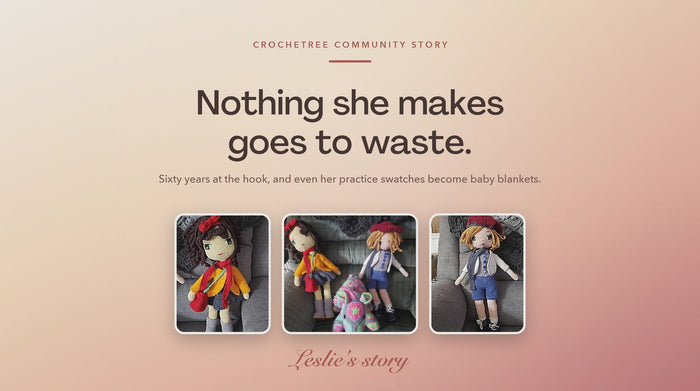
Since then Jean has made three dolls: two using the Hazel pattern and one Valentina. Both patterns were lovely to make and she genuinely cannot choose between them, because both dolls are adorable.

Ask her which of her projects she is proudest of and she will not narrow it to one. All of them, because she puts everything into every piece. What she does notice is the reaction. Her Crochetree dolls are much admired whenever she showcases them, and the comment she gets most often is how professional they look.

Jean's Practical Advice
Her headline advice is short: do not give up, and learn from your mistakes. Underneath it sit three techniques she uses constantly.
Stitch markers, in every project. She marks the first or last stitch of the round so she always knows where a round begins and ends.
The invisible decrease method, which prevents frogging and stops bumps from showing in the finished fabric.
And choosing your own colors. Picking the skin tone, the eye color, and the clothing and accessory shades is what turns a pattern into your doll rather than a copy of the photograph.
Where Crochet Sits in Her Days
Crochet plays a big role in Jean's daily life. She spends hours crocheting or researching patterns, and she absolutely loves it. It keeps her going and it hands her challenges she is proud of meeting.
Which is a striking outcome for the one craft she could not get.
Start Your Own Crochet Journey
If crochet is the skill that has not clicked for you yet, Jean's story is worth holding onto. Crochetree's Crochet Basics Beginner Course starts at the very beginning, with no assumed knowledge, and when you are ready for the doll that made Jean nervous, Hazel is right there. Or browse the full collection of doll patterns and find the one you keep coming back to look at.
Mistakes included, one stitch at a time, you can craft this.
Frequently Asked Questions
Can you learn to crochet from online tutorials alone?
Yes. Jean learned entirely from internet tutorials after years of knitting, and within three years she was making detailed dolls. Video tutorials let you pause, rewind, and watch a stitch as many times as you need, which is often easier than learning from a person who moves at their own pace.
Is crochet doll hair as hard as it looks?
It looks far harder than it is. Doll hair was the exact thing that made Jean hesitate before starting Hazel, and it turned out not to be nearly as complicated as she had feared. Crochetree wigs are worked as one piece, with the curls created by increases as you go, so you are not attaching hundreds of separate strands.
What are stitch markers for in crochet?
They mark your place. Jean uses one on the first or last stitch of every round so she always knows where a round begins and ends, which matters enormously in amigurumi where you work in a continuous spiral with no obvious seam. It is the single cheapest way to stop losing count.
What is an invisible decrease and why should I use it?
It is a way of decreasing that works through the front loops only, so the reduction disappears into the fabric instead of leaving a visible bump. Jean recommends it specifically because it prevents the lumps that otherwise show on a doll's face and body, and it saves you from frogging work you were nearly happy with.