

If you've ever looked at a crochet pattern and wondered, what does DC mean in crochet, you've come to the right place. The short answer is it stands for Double Crochet. This is one of the most fundamental stitches you'll learn, and it's a real workhorse that helps your projects grow quickly and beautifully.
Decoding DC in Crochet
Diving into crochet is like learning a new language, and understanding the abbreviations in a pattern is your first key to unlocking it. When you see "dc" pop up, it’s signaling you to make one of the most common and versatile stitches around.
Think of the double crochet as a trusty building block. It’s taller than its shorter cousins, the single crochet (sc) and half double crochet (hdc), which is wonderful because it adds height to your work much faster. This makes it a go-to for projects where you want to see quick progress, like cozy blankets, flowing scarves, and airy shawls.
One of the first little quirks new crocheters discover is that there are two main "dialects": US terms and UK terms. This is where "dc" can be a bit confusing, but don't worry, it's an easy puzzle to solve once you know the secret.
This handy diagram breaks down the main difference you need to know for the double crochet stitch.
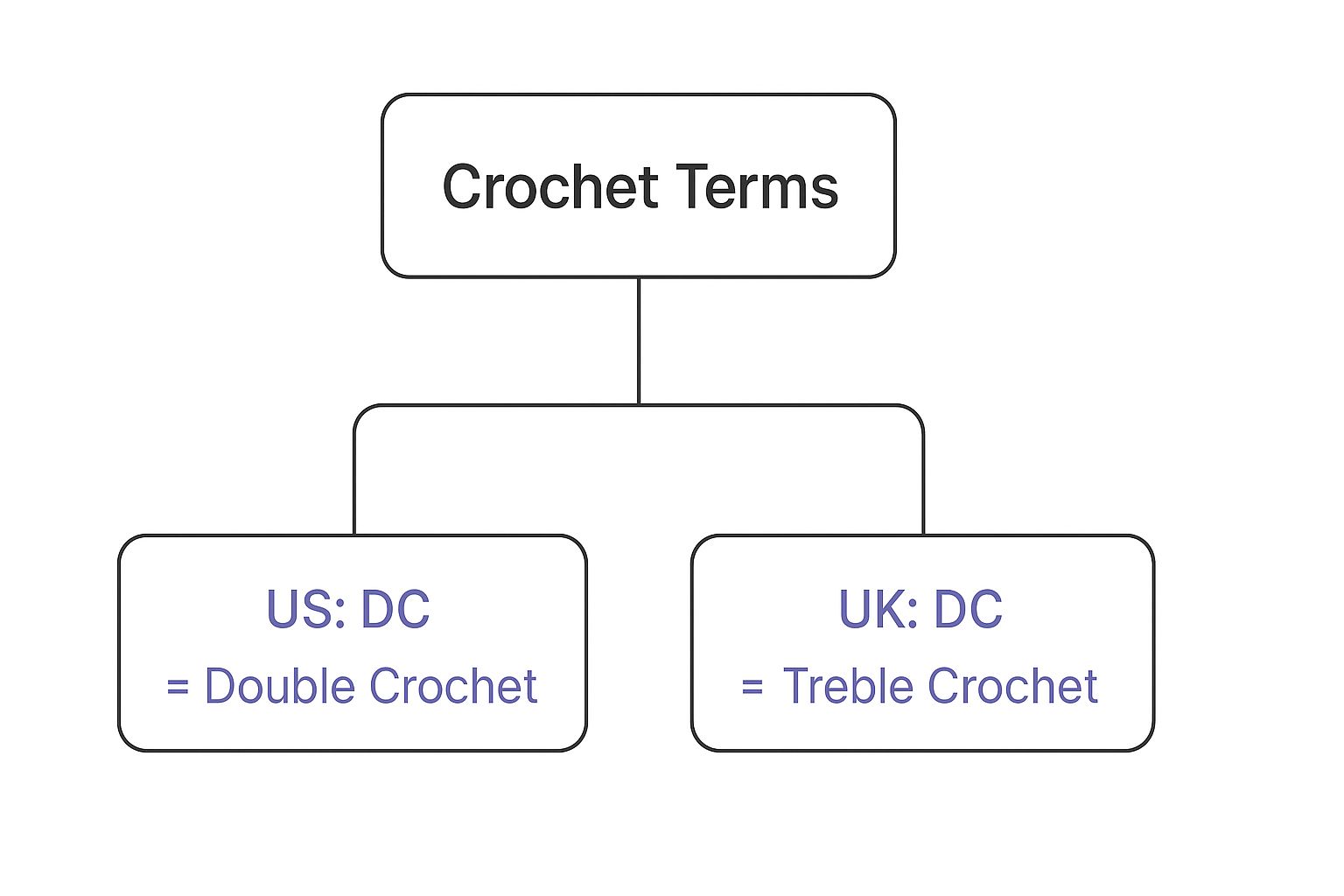
As you can see, what we call a double crochet in the US is known as a treble crochet in the UK. This is why it's so important to check which terminology your pattern is using before you start!
To put it simply, 'dc' in a US pattern means you'll yarn over once, insert your hook, and finish the stitch in two movements. But in a UK pattern, their 'dc' (double crochet) is actually the much shorter stitch we know as a 'single crochet' in the US. It's a classic mix-up!
US vs UK Crochet Terms Quick Reference
To help you navigate any pattern with confidence, here’s a quick comparison of the most common stitch names and abbreviations. It’s a great little cheat sheet to keep handy.
|
Stitch Name |
US Abbreviation |
UK Abbreviation |
|---|---|---|
|
Single Crochet |
sc |
dc (double crochet) |
|
Half Double Crochet |
hdc |
htr (half treble crochet) |
|
Double Crochet |
dc |
tr (treble crochet) |
|
Treble Crochet |
tr |
dtr (double treble crochet) |
Getting these terms straight will save you so much confusion and make reading patterns from anywhere in the world a joyful experience.
Mastering this stitch and other basic crochet stitches for beginners is what truly opens the door to countless creative projects. Once you have the hang of it, you’ll be crafting with joy and confidence.
How to Master the US Double Crochet Stitch
Alright, now that you know what dc means in crochet, it’s time for the really fun part, actually making the stitch! Learning the US double crochet feels a lot like finding a simple, comforting rhythm. Once your hands get the hang of the motion, it’s one of those stitches you can almost do with your eyes closed.
So let’s walk through this beautiful stitch together. Grab your hook and yarn, take a deep breath, and let's get started.
Your Step-by-Step Guide
The double crochet stitch is made with four simple, flowing movements. The key is to avoid rushing and just find a pace that feels natural for you.
- Yarn Over (yo): First, wrap the yarn over your hook from back to front. You should have two loops sitting on your hook.
- Insert Your Hook: Now, guide your hook into the stitch where you want to create your dc.
- Yarn Over and Pull Up a Loop: Wrap the yarn over the hook again, and this time, pull that loop through the stitch. You'll now have three loops on your hook. This is the perfect spot to pause and check your work.
- Complete the Stitch: Yarn over one more time and pull through the first two loops on your hook. You'll be left with two loops. To finish, yarn over again and pull through those final two loops. That’s it, you’ve made a double crochet!
Actionable Tip: Ready to practice? Grab some scrap yarn and crochet a small square using only the double crochet stitch. Focus on the feel of the yarn in your hands and the rhythm of the four steps. This simple exercise builds muscle memory and confidence!
Tips for Perfect Stitches
Getting your stitches to look neat and even is all about consistency. This is especially true for your tension, how tightly or loosely you hold the yarn. It’s a skill that comes with practice, not overnight perfection, so be kind to yourself.
A common hurdle for beginners is figuring out the turning chain. When working in rows of double crochet, you’ll usually chain 3 at the start of a new row. This chain does an important job: it lifts your yarn to the right height for the new row and often counts as your very first stitch. This is the secret to getting those lovely, straight edges on your projects.
Most importantly, remember to be patient. Every single crafter started right where you are, and every stitch you make is another step forward on your own creative path.
Decoding US vs. UK Crochet Terms
One of the biggest hurdles when you first start reading patterns is discovering that crochet has two different "languages", US and UK terminology. This is where the simple question of what does dc mean in crochet gets a little more complex. But don't worry, we're here to make it simple.
Think of it like following a recipe from another country. If a US pattern asks for a double crochet (dc), it’s calling for the taller stitch we’ve been talking about. But if a UK pattern asks for a double crochet (dc), it’s actually asking for what a US crocheter calls a single crochet, a much shorter, tighter stitch!
Using the wrong one can completely change the size, shape, and drape of your final piece. It's the most common reason a project comes out looking nothing like the picture!
How to Tell Which Terms a Pattern Is Using
This mix-up might sound intimidating, but there are easy clues to look for. With a little practice, you'll be able to spot a pattern's origin in seconds, opening up a whole world of beautiful designs.
Look for "Single Crochet" (sc): This is your biggest hint! The single crochet stitch only exists in US terminology. If you see "sc" anywhere in the pattern, you can be 100% certain it's written in US terms.
Check the stitch height: If a pattern uses dc for a blanket and it works up quickly into a drapey fabric, it's almost certainly a US dc. A UK dc (our single crochet) would create a very dense, slow-growing material instead.
Note the designer's location: Often, a designer will mention where they are based on their blog, pattern site, or social media. A designer from North America will almost always use US terms, while one from the UK, Australia, or South Africa will likely use UK terms.
Believe it or not, this difference is a huge deal in the crafting world. Many online patterns follow US terminology, and this specific confusion over the 'dc' stitch is responsible for many project mistakes for crafters who switch between pattern sources. It's a classic beginner moment, but one you can now easily avoid.
Once you know what to look for, you gain the confidence to pick up any pattern, from any designer, and create something beautiful. Just as you master the double crochet, you can also learn about its slightly shorter cousin, the half double crochet, in our detailed guide.
Why You Will Love the Double Crochet Stitch
So, why do so many crocheters fall in love with the double crochet stitch? It’s all about the joy of seeing your hard work pay off, fast. Because this stitch is taller than a single or half double crochet, your projects seem to fly off the hook. This gives you that wonderful hit of satisfaction that keeps you coming back for more.
The double crochet is truly a workhorse in your crafting toolbox. It’s perfect for whipping up everything from a thick, cozy blanket to a light, drapey shawl. It really hits that sweet spot between working up quickly and creating a beautiful, detailed fabric, letting you finish projects you can be proud of in less time.
A Stitch of Endless Possibilities
Think of the double crochet as a key that opens up a whole new world of creative textures. Just by swapping your hook size or yarn, you can completely change the fabric you’re making. It’s this adaptability that makes it so much fun to play with.
For example, you can create:
- A dense, warm fabric for winter hats and scarves by using a smaller hook.
- A light, airy lace for summer tops and market bags by sizing up your hook.
- A beautifully draped material for throws and cardigans that feels wonderfully soft and flexible.
This stitch is so much more than just a series of motions; it’s a core skill that will serve you well for years and years of crafting.
By mastering the double crochet, you’re not just learning a stitch, you're building the confidence to turn your creative daydreams into reality. It’s a simple technique that creates beautiful, tangible results, reminding you of the magic you can make with your own two hands.
Learning what dc means in crochet is only the first step. When you truly embrace this stitch, you open yourself up to a world of faster, more versatile, and more joyful crafting. It’s a skill that will grow right along with you, one project at a time.
Choosing the Perfect Yarn for Your Project
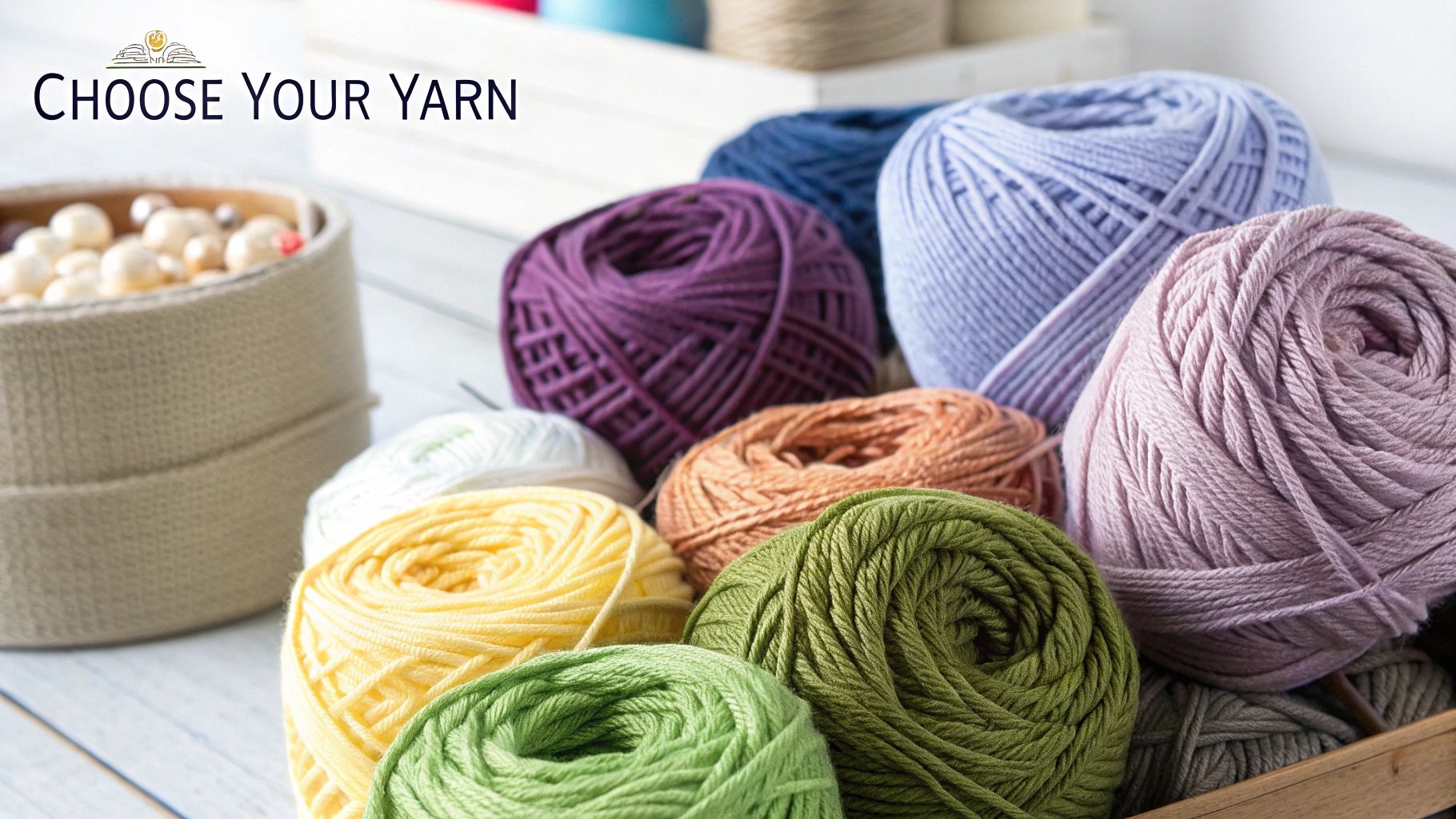
The right yarn can make your double crochet stitches truly sing. Picking a yarn isn't about finding the one "best" option; it's about finding the perfect partner for your project. Think of it like cooking: the ingredients you choose completely shape the final dish.
A smooth yarn will show off the beautiful definition of each double crochet, while a fluffy yarn will create a wonderfully plush and cozy fabric. Understanding how different fibers behave is the secret to bringing your creative vision to life.
A Quick Guide to Common Yarns
There is a whole world of yarn fibers to explore, and each one has its own personality. Here’s a quick look at some popular choices that work beautifully with the double crochet stitch:
Cotton blends (DK/worsted): Breathable and easy to care for, good for summer garments, dishcloths, and homeware.
Acrylic (mostly worsted): Budget-friendly and machine-washable, common for blankets and everyday projects (note potential for pilling/static).
Wool/wool blends: Warm, elastic, and has great stitch recovery, perfect for hats and sweaters, but always check care instructions and consider skin sensitivity.
Chenille/faux-fur: Creates a plush, cozy texture for blankets and pillows, but it's not recommended for beginners learning stitches, as visibility is low.
Choosing your yarn is an invitation to think about how you want your finished project to feel. Do you envision something soft and drapey, or sturdy and structured? This simple question will guide you to the perfect choice.
Ultimately, the goal is to find a yarn that makes you happy and works for what you have in mind. Whether you’re making a gift or something special for yourself, the right texture and color can make the whole process even more joyful. For a deeper dive, check out our guide on choosing the perfect yarn for your crochet project.
Avoiding Common Double Crochet Mistakes
Let’s be honest: every single crafter makes mistakes. It’s a beautiful, essential part of learning something new with our hands. So, try to think of each little hiccup not as a failure, but as your yarn teaching you something important.
We're here to help you troubleshoot those common bumps in the road, turning frustration into confidence.
One of the most frequent hurdles is inconsistent stitch height. If you look at your work and see some double crochets are towering over others, you might have accidentally slipped in a half double or even a single crochet. This usually happens from forgetting one of the final "yarn over, pull through two loops" steps. It's an easy mix-up!
Another familiar sight? Wavy or ruffled edges. This is almost always caused by adding too many stitches in a row, and the culprit is often the turning chain. Remember, the chain-3 at the start of a double crochet row usually counts as your very first stitch. If you also work into the stitch at the base of that chain, you're accidentally adding an extra stitch to every row.
Solving Common Stitch Problems
Let’s gently untangle these common issues with a few simple fixes. The goal here is to build your skill so you can spot and solve these little challenges all on your own.
Problem 1: Uneven or Gappy Fabric
- The Cause: This is the classic sign of uneven tension, how tightly or loosely you hold your yarn. It happens to everyone. Sometimes we crochet tighter when we're concentrating hard and looser when we finally relax into the rhythm.
- The Fix: Take a few deep breaths and find a comfortable, consistent way to wrap the yarn around your fingers. Try making a small practice swatch where your only goal is to make each stitch feel the same as the one before it. No pressure!
Problem 2: Stitches Are Too Short or Tall
- The Cause: You might be missing a yarn over or pulling through the wrong number of loops by mistake. With multiple steps, it’s easy to lose track.
- The Fix: Slow everything down and count the steps out loud. Seriously, it helps! "Yarn over, insert hook, yarn over, pull up a loop (three on the hook), yarn over, pull through two, yarn over, pull through two.” This mindful rhythm is fantastic for building muscle memory.
Remember, every mistake is just a lesson in disguise. Being a crocheter isn't about being perfect; it's about the joy of creating and the resilience you build with every stitch you learn to fix.
Frequently Asked Questions About Double Crochet
Let's clear up a couple of common questions that pop up when you're getting the hang of the double crochet stitch. These little details can make a big difference in your projects!
How Many Chains Do I Need for a Double Crochet Turning Chain?
The magic number is usually three. When you finish a row of double crochet and want to start the next one, you’ll typically chain 3. If you don't want your chain to count as a stitch, then you can chain 2.
This little chain acts like a ladder, bringing your yarn up to the right height for the new row. Some patterns will also count this turning chain as the very first double crochet stitch of that row, so keep that in mind as you count your stitches.
Is a Half Double Crochet the Same as a Double Crochet?
Nope, they're definitely different stitches! Think of them as cousins. A half double crochet (hdc) is shorter than a double crochet (dc).
The main difference is in the final step. For an hdc, you pull your hook through all three loops at once. With a dc, it's a two-step process: you pull through two loops, and then you pull through the last two loops.
Learning the double crochet is a wonderful step in your crafting journey. Embrace the process, be patient with yourself, and have fun bringing your ideas to life.
![The Ultimate Beginner's Guide to Crochet [2026]](http://crochetree.com/cdn/shop/articles/feat-ultimate-beginners-guide-to-crochet_eae81cec-84d0-455d-b190-08cd22d826c4.jpg?v=1777713815&width=700)
