
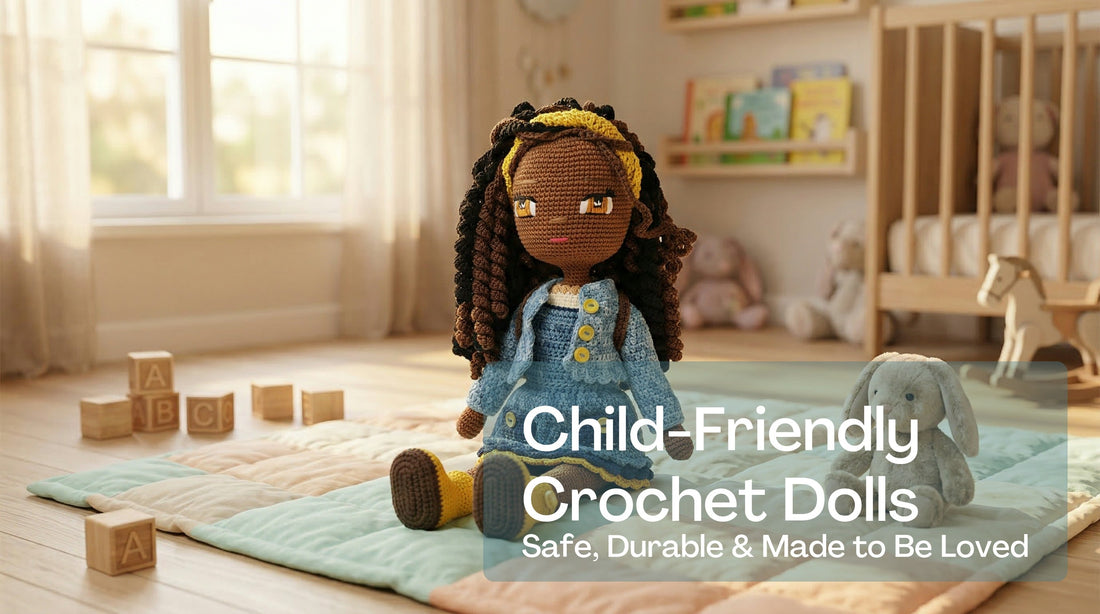
There's a real difference between a crochet doll that sits beautifully on a shelf and one that survives being dragged to the park, tucked into bed every night, and "fed" imaginary soup. Both are wonderful, but if you're making a doll for a child, durability and safety need to be part of your plan from the very first stitch.
The good news? Making a child-safe crochet doll doesn't mean sacrificing cuteness or creativity. It just means making a few smart choices about materials, construction, and finishing. Whether you're crocheting for your own little one, a grandchild, or a gift, this guide will walk you through everything you need to know to create a durable amigurumi doll that's safe, washable, and built to be truly loved.
Let's get into it 💛
Display Dolls vs. Play Dolls, Know the Difference
Before you begin, it helps to decide what kind of doll you're making. A display doll, the kind that sits on a shelf or decorates a nursery, can use any materials you like: delicate yarns, glued-on accessories, tiny buttons, wire armatures. It's meant to be looked at, not handled roughly.
A play doll is a completely different project. It needs to withstand pulling, chewing, washing, and the unpredictable force of toddler love. Every material and technique choice should pass one test: "Is this still safe and intact after 100 washes and 1,000 hugs?"
Many of our crochet doll patterns can be adapted for either purpose. The pattern stays the same, but your material and finishing choices make all the difference. Let's start with the most important one.
Choosing the Right Yarn
The yarn you choose affects everything: safety, washability, durability, and how well the doll holds its shape over time. Here's how the main fiber types compare for child-safe crochet dolls:
| Yarn Type | Child-Safe? | Washable? | Durability | Best For |
|---|---|---|---|---|
| Cotton | Yes, hypoallergenic | Machine washable | Excellent | Baby toys, play dolls, sensitive skin |
| Acrylic | Yes | Machine washable | Very good | Budget-friendly play dolls, bright colors |
| Cotton-Acrylic Blend | Yes | Machine washable | Excellent | Best of both worlds, soft, sturdy, easy care |
| Wool | Caution, allergenic | Hand wash only | Good | Display dolls, older children only |
| Novelty / Fuzzy | No, fibers can detach | Varies | Poor | Display only, never for young children |
Our recommendation: For play dolls, reach for cotton or a cotton-acrylic blend. Cotton gives you clean stitch definition (important for tight amigurumi fabric), it's naturally hypoallergenic, and it gets softer with every wash. Browse our yarn collection to find the right weight and color for your project.
Avoid novelty yarns, eyelash, bouclé, or chenille for any doll a young child will handle. Loose fibers can detach and become a choking hazard, and the fuzzy texture hides your stitches, making it harder to crochet a tight, secure fabric.
Stitch Tightness and Safety
This is one of the most important factors in crochet doll safety, and it's completely in your control. When you're making amigurumi for children, your fabric needs to be tight enough that no stuffing peeks through, even when the doll is squeezed, stretched, or sat on.
The Hook Size Rule
Go down 1–2 hook sizes from what your yarn label recommends. If your yarn suggests a 4mm hook, try a 2.5mm or 3mm. The goal is a dense, sturdy fabric with no visible gaps between stitches.
Here's a quick test: hold your crocheted piece up to a light source. If you can see light coming through the stitches, your fabric is too loose. A child-safe doll should have an opaque, tight fabric that keeps every bit of stuffing safely inside.
Why This Matters for Safety
- Stuffing exposure: Loose stitches allow polyester fiberfill to poke through. Small children can pull out tufts of stuffing and put them in their mouths.
- Structural weakness: A loose fabric stretches and distorts faster. Limbs droop, heads wobble, and seams pull apart under stress.
- Longevity: Tight stitches simply last longer. The doll keeps its shape through hundreds of play sessions and washes.
It might feel slow at first, crocheting with a smaller hook takes more effort per stitch. But once you see how firm and professional the finished piece looks, you won't want to go back. Your stitches are the doll's armor.
Child-Safe Features: Eyes, Noses, and Details
This section is critical for anyone making a baby-safe crochet toy. The features you add to a doll's face are the most common choking hazard, so your choices here really matter.
| Feature Type | Age Range | Safety Level | Notes |
|---|---|---|---|
| Embroidered eyes | All ages (0+) | Safest | Cannot be removed; fully washable |
| Crocheted features | All ages (0+) | Safest | Sewn-on crochet circles, noses, no hard parts |
| Safety eyes (with washers) | 3+ years | Good | Secure when installed correctly; not for babies |
| Buttons | 3+ years only | Moderate | Can be pulled off; reinforce heavily if used |
| Glued-on beads / sequins | Never for children | Unsafe | Glue weakens over time; serious choking hazard |
For babies and toddlers (0–3 years): Use embroidered features exclusively. French knots, satin stitch, and simple straight stitches can create beautiful, expressive faces that are 100% safe. Our Daisy Base Doll pattern is a great starting point, the embroidered face is charming and completely child-safe.
For older children (3+ years): Safety eyes with locking washers are a solid choice. Make sure the washer clicks firmly onto the post and cannot be removed without tools. Always install safety eyes before stuffing, you need access to the inside of the piece to secure the washer properly.
A good rule of thumb: if the child still puts things in their mouth, skip anything that isn't yarn.
Strong Assembly Techniques
A child doesn't gently set down a doll's arm. They grab it, yank it, swing the whole doll by it, and then wonder why it came off. Your assembly technique needs to anticipate this kind of love.
Sewing Limbs Securely
- Use the same yarn you crocheted with (or a matching cotton thread for extra strength). Avoid sewing thread, it's too thin and can cut through yarn fibers over time.
- Sew with a cross-stitch (X) pattern rather than a simple whip stitch. Go through the limb edge and the body, alternating directions to create a secure bond.
- Go around at least twice. One pass around the attachment point is the minimum. Two passes doubles the strength.
- Try thread jointing: Sew through the body from one arm to the other using a single long piece of yarn, so both arms share a continuous thread. This is incredibly strong and also lets the arms move slightly, kids love that.
Attaching the Head
The head-to-body joint takes the most stress. Pin it in position first, then sew all the way around the neck opening, not just a few points. Use a mattress stitch or whip stitch, pulling snug as you go. When you're done, weave the tail back through several body stitches and pull tight before cutting.
Stuffing Best Practices
The stuffing inside your durable amigurumi doll affects its shape, weight, and washability. Here's what works best for play dolls:
- Polyester fiberfill is the standard choice and the best for children's toys. It's lightweight, hypoallergenic, dries quickly after washing, and doesn't mold or mildew.
- Stuff firmly but not rock-hard. You want the doll to hold its shape without feeling like a stress ball. The head should be firm (it's the focal point), the body slightly less so, and the arms and legs a touch softer for flexibility.
- Add small amounts at a time. Pulling off tiny wisps of fiberfill and adding them gradually gives you a much smoother result than shoving in big clumps. Clumpy stuffing creates lumps that show through your fabric.
- Use the end of a chopstick or a stuffing tool to push fiberfill into small pieces like arms, legs, and fingers. Your fingers are too wide to reach into narrow tubes evenly.
Avoid these for children's dolls: dried beans or rice (mold risk, choking hazard if the fabric tears), wool roving (clumps when wet), and craft batting cut into pieces (uneven, doesn't wash well).
Reinforcing High-Stress Areas
Certain parts of a doll take more abuse than others. Reinforcing these areas proactively saves you from repair work later, and keeps the doll safe throughout its life.
Areas That Need Extra Attention
- Neck joint: The most common failure point. Sew the head on with an extra pass. Some makers add a few stitches through the center of the head and into the body for an invisible internal anchor.
- Arm and leg attachments: Use the thread-jointing technique described above. If the limbs are separate pieces, consider crocheting them directly onto the body instead of sewing, this eliminates the seam entirely.
- Hair: If your doll has yarn hair, secure each strand with a knot on the inside, then sew over the attachment points. Looped hair or crocheted hair caps are more durable than individual strands for play dolls.
- Small accessories: Hats, scarves, and tiny bags should be sewn on (or simply skipped for very young children). Never rely on friction or balance to keep an accessory in place, if it can come off, it will come off.

Making Your Crochet Doll Washable
A doll that can't be washed is a doll with a limited lifespan. Children spill, drool, drag things through mud, and occasionally sneeze directly onto their favorite toy. Washability is non-negotiable for play dolls.
The Washable Doll Checklist
- Yarn: Cotton or acrylic (both machine washable). Avoid wool and silk.
- Stuffing: Polyester fiberfill (dries fast, no mildew). Avoid natural fillers.
- Features: Embroidered or crocheted only. No glued elements, glue weakens and dissolves with repeated washing.
- Accessories: Sewn on securely, or removable by design (for older children).
- All yarn tails: Woven in and trimmed. Loose tails can unravel in the wash.
Washing Instructions
- Place the doll in a mesh laundry bag (this protects it from agitation and prevents snagging).
- Wash on a gentle/delicate cycle with cold water.
- Use a mild detergent, no bleach, no fabric softener (softener coats fibers and reduces absorbency).
- Do not tumble dry. Squeeze out excess water gently (don't wring), reshape the doll while damp, and lay flat to air dry.
After drying, you can fluff up any fiberfill that has settled by gently massaging the doll's body and limbs. It'll bounce right back to shape.
Testing Your Doll Before Gifting
Before you hand over your finished child-safe crochet doll, put it through a few simple tests. Think of this as quality control. It only takes a minute and gives you real peace of mind.
The Safety Test
- Pull test: Grab each limb, the head, any hair, and any accessories, and give them a firm tug. Nothing should come loose. Pull harder than you think a child would, because they will.
- Squeeze test: Squeeze the body and check if any stuffing peeks through the stitches. If it does, your fabric is too loose (see the stitch tightness section above).
- Mouth test: Look at your doll from a toddler's perspective. Is there anything small enough to fit in a mouth? Any loose ends, dangling threads, or small parts that could be bitten off?
- Wash test: Wash it once before gifting. This confirms that the yarn doesn't bleed, the shape holds, and everything stays attached.
If your doll passes all four tests, you've made something truly special, a toy that's as safe as it is beautiful. That's the mark of a thoughtful maker 🌷
Why Durability Is an Act of Care
There's something deeply meaningful about making a toy that lasts. When a child's favorite doll survives years of adventures, bedtime stories, tea parties, trips to grandma's house, and that one time it accidentally went through the washing machine, it becomes more than a toy. It becomes a companion. A comfort object. A piece of their childhood.
Every tight stitch, every reinforced seam, every thoughtful material choice is an invisible act of love. The child will never know you went down two hook sizes or sewed the arms on twice. But they'll know that their doll is always there, always intact, always ready for the next adventure.
That's what makes handmade so special. You're not just crocheting a toy, you're crafting a memory.
Ready to get started? Browse our full collection of crochet doll patterns and find your next project. Every pattern can be adapted for child-safe construction using the techniques in this guide. You can craft this 💛
Frequently Asked Questions
Are safety eyes safe for babies and toddlers?
Safety eyes with locking washers are generally considered safe for children over 3 years old when installed correctly. However, for babies and toddlers, we recommend skipping plastic eyes entirely and using embroidered eyes instead. Even well-attached safety eyes can become a choking hazard if a determined toddler manages to pry one loose. Embroidered features are the only truly baby-safe option for child-safe crochet dolls.
What is the best yarn for a child-safe crochet doll?
Cotton yarn or cotton-acrylic blends are the best choice for baby-safe crochet toys. Cotton is hypoallergenic, machine washable, and holds its shape beautifully through play and washing. Acrylic is also a solid budget option, it's durable, easy to wash, and available in every color you can imagine. Avoid wool (potential allergen) and novelty yarns (loose fibers pose a choking hazard). Check out our yarn collection for child-safe options.
How do I make a crochet doll machine-washable?
Use cotton or acrylic yarn (both are machine washable), stuff with polyester fiberfill (it dries quickly and resists mold), and use only embroidered features, no glued-on elements. Make sure all yarn tails are securely woven in. When it's time to wash, place the doll in a mesh laundry bag, wash on gentle with cold water, and air dry flat. Your doll will come out looking fresh and ready for more adventures.
How tight should my stitches be for an amigurumi doll?
Tight enough that no stuffing shows through when the piece is filled. A good rule of thumb: go down 1–2 hook sizes from the recommended size on your yarn label. If your yarn suggests a 4mm hook, try a 2.5mm or 3mm for your durable amigurumi pieces. Hold your crocheted fabric up to a light, if you can see light between stitches, go smaller. A dense fabric keeps stuffing in, holds its shape, and lasts much longer through rough play.
How do I reinforce the arms and legs on a crochet doll?
Sew limbs on with a cross-stitch (X) pattern rather than a simple whip stitch, and go around the attachment point at least twice. Use the same yarn you crocheted with for a strong, consistent bond. For extra durability, try the thread jointing technique: sew through the body from one arm to the other using a single continuous piece of yarn, so both arms share one strong thread. This makes the joints extremely secure, even the most enthusiastic little arms won't pull them apart.


