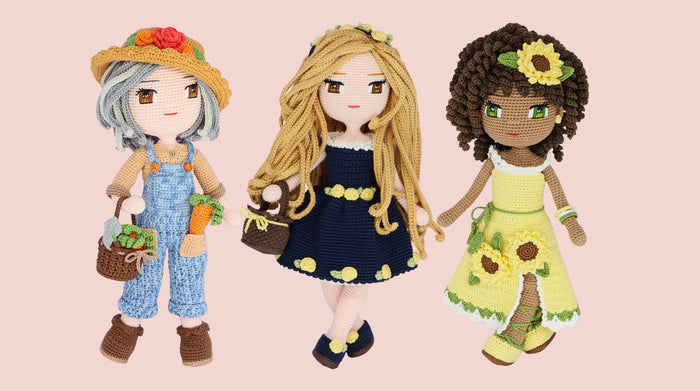
You've probably noticed it before, even if you couldn't quite name it. A scarf someone knitted for you feels different when you wrap it around your neck. A wonky clay mug your child made holds your coffee a little better than the matching set from the store. A crochet doll you stitched yourself sits on the shelf and means something the purchased one beside it simply doesn't.
That feeling isn't sentimental exaggeration. There's real science, and real human experience, behind why handmade feels different from anything you can add to a cart and have delivered by Thursday.
This post explores what actually happens when you make something with your hands, why it changes how you relate to objects (and to yourself), and why the quiet act of creating might be one of the most underrated things you can do for your wellbeing.
Making Engages Your Mind, Body, and Attention
When you buy something, the transaction is simple: money leaves, object arrives. Your hands might tap a screen. Your mind might compare two options for a few minutes. Then it's done.
When you make something, the experience is fundamentally different. Your hands, your eyes, your focus, and your decision-making all work together, sometimes for hours, sometimes for weeks. The benefits of handmade crafts start right here, in this full-body engagement that buying can never replicate.

| Buying Something | Making Something by Hand |
|---|---|
| Passive decision (choose, pay, receive) | Active engagement (plan, create, problem-solve) |
| Hands tap a screen or swipe a card | Hands shape, stitch, mold, or carve |
| Attention spans seconds to minutes | Attention spans hours to weeks |
| Result arrives finished | Result emerges gradually through effort |
| Connection to the object is transactional | Connection to the object is personal |
| Satisfaction peaks at unboxing, then fades | Satisfaction builds during the process and lasts |
This isn't about judging one over the other. We all buy things we need. But when we talk about why handmade feels different, it begins with this gap between passive consumption and active creation.
Time Changes Value: The IKEA Effect
In 2011, researchers at Harvard, Yale, and Duke published a study on something they called the IKEA effect, the finding that people place significantly higher value on objects they helped build, even when the result was objectively no better (and sometimes worse) than a store-bought equivalent.
Participants who assembled simple IKEA furniture were willing to pay 63% more for their own creations than for identical pre-assembled pieces. The effort itself created value.
Now imagine that effect scaled up. Not snapping together a flat-pack shelf, but spending fifteen hours crocheting a doll from a single strand of yarn. Choosing the colors. Counting the stitches. Embroidering a tiny face. The IKEA effect doesn't just apply; it multiplies.
This is why a crochet pattern you made yourself can feel more valuable than something far more expensive from a shop. You didn't just spend money. You spent time, and your brain knows the difference.
You Become Part of the Object
Here's something most people don't think about: when you crochet a doll, knit a blanket, or sew a quilt, you are literally encoded in the finished piece.
Your tension that day. Your mood. The music you were listening to. The color you almost chose but didn't. The row you had to frog and redo because you lost count. Every small decision and correction becomes part of the fabric, invisible to anyone else, but deeply known to you.

A purchased object has a manufacturer. A handmade object has a maker — and that maker's presence lives in every stitch. This is what separates handmade vs store bought at the deepest level. It's not just about quality or aesthetics. It's about presence.
Your choices shape the outcome
When you follow a crochet pattern, you're not just executing instructions. You're choosing the yarn weight and color. You're deciding how tightly to hold the hook. You're interpreting the pattern through your own hands. Two people can follow the exact same pattern and produce two noticeably different results, because the maker is always part of what gets made.
Making Slows the Mind
We live in a world that rewards speed. Fast shipping. Fast scrolling. Fast answers. And while speed has its place, something important gets lost when everything moves that quickly: the ability to be present.
This is where crochet mindfulness enters the picture, not as a trendy wellness buzzword, but as a real, felt experience that millions of makers know intimately.
When you sit down with a hook and yarn, the rhythm of the stitches creates a gentle, repetitive pattern that quiets the mental noise. Your breathing slows. Your shoulders drop. The anxious loop of tomorrow's to-do list fades into the background because your hands are busy doing something that requires just enough attention to keep you anchored in right now.
Research backs this up. A 2013 study in the British Journal of Occupational Therapy found that 81% of knitters and crocheters with depression reported feeling happy after crafting. Repetitive hand movements have been shown to lower cortisol (the stress hormone) and activate the parasympathetic nervous system, the body's built-in calm-down switch.
You can't get that from a checkout page. 💛

Ownership vs. Relationship
When you buy a sweater, you own it. When you make a sweater, you have a relationship with it.
That distinction matters more than it might seem. Ownership is about possession, having something, storing it, and eventually replacing it. A relationship is about connection, remembering, caring, repairing, rather than discarding.
This is why handmade items get mended instead of thrown away. It's why the crochet blanket your grandmother made still sits on the couch decades later, while dozens of store-bought throws have come and gone. The object earned its place not through price but through meaning.
The lifecycle of handmade vs. store-bought
| Store Bought | Handmade | |
|---|---|---|
| Acquisition | Purchased in minutes | Created over hours or weeks |
| Attachment | Peaks at unboxing | Deepens over time |
| When damaged | Often replaced | Often repaired |
| When outgrown | Donated or discarded | Passed down or treasured |
| Emotional weight | Low — it's a thing | High — it's a story |
Handmade Carries Memory
Every handmade object is a time capsule. Not in a dramatic, museum-exhibit way — in a quiet, personal way.
The baby blanket you crocheted during your first pregnancy. The scarf you made on a long train ride through Portugal. The amigurumi doll you stitched while recovering from surgery. These objects don't just sit in your home. They hold pieces of your life.
When you give a handmade gift, you're not handing over a product. You're handing over hours of your attention, dedicated to that person. The recipient may not know which stitches gave you trouble or which rows you completed at midnight, but they can feel the difference. That's why handmade gifts make people emotional in ways that even expensive store-bought gifts rarely do.

Making Rebuilds Self-Trust
There's a particular kind of confidence that comes from finishing something you made with your hands. It's different from the confidence of a promotion or a compliment. It's quieter, steadier, and entirely self-generated.
When you complete a crochet project, especially one that challenged you, something shifts. You proved to yourself that you can learn something new. That you can follow through. That you can sit with frustration, work through mistakes, and come out the other side holding something real.
For beginners especially, this feeling is transformative. The first time you finish a granny square that actually looks like a square, or complete a small amigurumi and realize you made that. It rewires something. The internal narrative shifts from "I'm not crafty" to "Actually, maybe I am." 🌷
This is one of the most overlooked benefits of handmade crafts: they rebuild your trust in your own ability to learn, create, and follow through.
It doesn't have to be perfect to be powerful
You don't need to produce gallery-worthy work for this effect to kick in. The simple act of starting, continuing, and finishing is enough. Every completed project — no matter how small — adds a brick to the foundation of creative self-trust.
Why Handmade Feels More Human
Mass production is designed to eliminate variation. Every unit identical. Every seam the same. Every color matched to a Pantone swatch. And there's nothing wrong with that — consistency has value.
But perfection, it turns out, doesn't make us feel much.
Handmade objects carry imperfections — a slightly uneven stitch, a color shift where a new skein began, a tiny asymmetry in an embroidered face. And these imperfections are exactly what make handmade feel alive. They're evidence that a human being — not a machine — was here.
In Japanese aesthetics, there's a concept called wabi-sabi: the beauty of imperfection, impermanence, and incompleteness. Handmade crafts embody wabi-sabi naturally. Every piece is one-of-a-kind, not because a marketing team decided to label it "artisan," but because a real person made it with real hands on a real Tuesday afternoon.
That's why handmade feels more human. Because it is more human.

Start Making Something Today
If reading this stirred something in you, a memory of making, a curiosity about starting, or just a quiet recognition that you've been consuming more than creating lately — that's worth paying attention to.
You don't need expensive supplies. You don't need talent. You don't need to produce something Instagram-worthy. You just need a hook, some yarn, and the willingness to try.
If you've never crocheted before, Crochetree's Crochet Basics Beginner Course will walk you through every stitch from the very beginning, no experience required. And if you're ready to dive into a project, browse our full pattern collection for dolls, outfits, animals, and more.
Because the thing about making something with your hands is this: the object you create is only part of what you get. The real gift is what happens to you in the process.
You can craft this. 💛
Frequently Asked Questions
Why does handmade feel different from store bought?
Handmade items carry the time, attention, and personal choices of the person who made them. Unlike mass-produced goods, every stitch reflects a unique moment of focus and care. Research on the IKEA effect shows we value things more when we invest effort into creating them — which is why handmade feels different from anything we simply purchase.
What are the mental health benefits of handmade crafts?
The benefits of handmade crafts include reduced anxiety, lower cortisol levels, and improved focus. Crafts like crochet activate a calm, meditative state through repetitive hand movements, helping you feel grounded and present. Many crafters report significant improvements in mood and stress levels.
Is crochet good for mindfulness?
Absolutely. Crochet mindfulness is a well-documented phenomenon. The rhythmic, repetitive motion of the hook creates a gentle flow state that quiets racing thoughts without being so demanding that it causes stress. It's one of the most accessible forms of active meditation available.
Why do we value things we make ourselves more than things we buy?
Psychologists call this the IKEA effect. When you invest time, decisions, and physical effort into making something, your brain forms a deeper emotional attachment to it. The object becomes part of your personal story — not just something you own, but something you created.
How do I start making things by hand if I'm a complete beginner?
Start with a forgiving craft like crochet. All you need is a hook and some yarn. Crochetree's Crochet Basics Beginner Course teaches every fundamental stitch step by step, so you can go from zero experience to finishing your first project with confidence.