

Welcome to the wonderful world of crochet, where a simple strand of yarn can become something truly special. Every single project, whether it's your first washcloth or an intricate blanket, begins with one fundamental technique: the slip knot. Learning how to create a slip knot for crochet is the first real step on your journey to mindful crafting and endless creativity.
Your First Step in Every Crochet Project
Think of the slip knot as the handshake that introduces your yarn to your hook. It’s the adjustable loop that anchors everything, letting you build your first chain and officially begin your project. Getting this right from the start really sets a positive, confident tone for your entire making session.
The slip knot has been a cornerstone of both crochet and knitting for ages. It's essentially a type of stopper knot that can be undone in an instant just by pulling the tail end. Its simple, clever design is likely why it became such a timeless starting point in the fiber arts.
This small but mighty knot is the foundation for everything that comes next. It's how you:
Securely attach the yarn to your crochet hook.
Create an adjustable loop that you can tighten or loosen as needed.
Establish the starting point for your foundation chain.
Don't worry if it feels awkward at first. Every single person who crochets has been exactly where you are now. With a little bit of practice, making a slip knot will become pure muscle memory, a quiet little ritual that kicks off each new creation. For more tips on getting started, our guide on how to start crocheting is a great next step.
How to Create the Perfect Slip Knot for Crochet
Alright, let's get you started. Every single crochet project begins with this one simple motion: the slip knot. Please don’t worry about getting it right on the first try. This is all about gentle practice and finding what feels most natural in your hands.
We're going to walk through two great options. One is the Simple Loop Method, which is fantastic if you're a visual learner. The other is the Over-the-Fingers Method, perfect for those who learn by feel. Both get you to the same place, so you can just pick the one that clicks.
The Simple Loop Method
I often recommend this method to absolute beginners because you can literally see the knot forming right in front of you. It’s a great way to understand the mechanics of how the knot works before you start trying to wrangle the yarn in your hands.
- Start by laying your yarn on a flat surface, leaving a tail about six inches long.
- Make a loop by crossing the tail end under the working yarn (that's the yarn still attached to the ball).
- Now, reach your fingers through that loop, grab the working yarn, and pull a new loop through. That's it! You've made an adjustable slip knot.
The Over-the-Fingers Method
If you prefer a more hands-on approach, this method uses your fingers as the frame. It feels very fluid once you get the hang of it, and it quickly becomes muscle memory for most crocheters.
- Drape the yarn over your index and middle fingers, with the tail end hanging down in front.
- Wrap the working yarn around the back of those same two fingers and cross it over the tail, making an 'X' shape.
- Slide your crochet hook under the first strand (the tail end), hook the second strand (the working yarn), and pull it right through to create your loop.
There are a few ways to tie a slip knot, and there’s no "right" or "wrong" one as long as it works! Here's a quick comparison to help you choose.
Two Beginner-Friendly Slip Knot Methods
|
Method |
Best For |
Key Action |
|---|---|---|
|
Simple Loop |
Visual learners; seeing how the knot is constructed. |
Creating a loop on a flat surface and pulling the working yarn through. |
|
Over-the-Fingers |
Tactile learners; building muscle memory quickly. |
Wrapping yarn around your fingers to create tension and form the loop. |
Give both a try and see which feels more intuitive. The one that feels less clumsy is the one for you!
No matter which way you do it, the result is a knot that slides easily to adjust the loop size but stays put once you start your first chain. Getting this right from the beginning really helps. In fact, some instructors have found that learners who master the slip knot properly tend to reduce their initial stitch mistakes. It sets a good foundation!
A Moment of Encouragement: Your hands will learn this motion with time. Be patient with yourself, take a deep breath, and remember that every single crocheter started right here, with this one simple knot. You're building a new skill, one loop at a time.
Choosing Your Tools For Practice
Picking the right tools can make all the difference, especially when you're just starting out. While you can technically make a slip knot with any old yarn, setting yourself up with the right kind makes it so much easier to see what your hands are doing and build that crucial muscle memory.
For these first practice runs, I always recommend grabbing a smooth, light-colored yarn. Trust me, trying to learn on dark or fluffy yarn is a recipe for frustration because it hides your stitches, making it nearly impossible to see the structure of the knot.
Your First Yarn
A worsted-weight yarn (a medium thickness, often labeled as a number 4) is perfect for beginners. It's chunky enough to hold onto comfortably without being too bulky.
- Acrylic: This is a fantastic choice for practice. It's budget-friendly, machine-washable, and its smooth texture means it won't split easily while you're learning.
- Cotton blends: These are also great to work with. They're breathable and give you beautiful, clear stitch definition so you can see exactly how your knot is forming.
Going with one of these options sets you up for a smooth, frustration-free experience, letting you focus on the simple, satisfying motions of making your first loops.
Selecting The Right Hook
Now, let's pair that yarn with a comfortable, medium-sized hook. I'd suggest starting with a 5mm (H-8) hook, which is the ideal companion for worsted-weight yarn. Its size is easy to grip and maneuver while you get the hang of handling both your tools and the yarn tension.
Getting familiar with how hook sizes work is a key part of your crochet journey. If you're curious to learn more, you can dive into crochet hooks, size, and gauge in our detailed guide.
Starting with simple, appropriate tools is an act of kindness to yourself. It removes unnecessary hurdles and lets you find the rhythm and joy in the craft from the very first loop you create.
As you start gathering your first supplies, keeping them neat can make your practice time feel even more calm and focused. For some great ideas on how to organize your craft supplies, check out this handy guide.
Troubleshooting Common Slip Knot Issues
Hitting a snag? Take a deep breath. It's a completely normal part of learning, and trust me, every single crocheter has been exactly where you are now. Let’s walk through the most common slip-knot slip-ups and get them sorted out without any frustration.
Think of these little hiccups not as failures, but as your yarn teaching you how it wants to be handled. Each attempt helps you understand how the hook and fiber work together, and soon you'll be fixing these things without a second thought.
My Knot Is Too Tight or Too Loose
This is, without a doubt, the most frequent challenge for beginners. If your loop is so tight you can barely get the hook in, you probably pulled both the tail and the working yarn at the same time. No big deal. Just gently pull the working yarn (the one attached to the ball) to make the loop bigger. To snug it up, give the tail end a little tug.
Your Goal: The loop should be snug enough to stay put on the hook but loose enough that it can glide smoothly up and down the shaft. Finding this sweet spot is your very first lesson in tension control.
Getting the feel for this adjustment is crucial. If you're consistently fighting with tension, our guide on why you can't get the hang of your tension in crochet is packed with deeper insights and exercises that can really help.
My Knot Won't Slide At All
If your knot is completely stuck and refuses to adjust, you’ve likely made a simple overhand knot by mistake. This usually happens if you cross the yarn the wrong way when forming the loop. A true slip knot has one job: to slip! If it's not doing that, it's not the right knot.
The Quick Fix: Don't fight with it. The easiest thing to do is just pull both ends to undo the knot completely and start fresh.
Try Again Mindfully: Go back to one of the methods we covered. This time, pay close attention to which strand of yarn, the tail or the working end, you pull through the loop. Only one of them will create that magical sliding action.
Remember, patience is your best friend here. Every attempt, whether it works out or not, is building muscle memory. Before you know it, making a slip knot will feel like second nature. You're doing great!
How a Good Slip Knot Shapes Your Project
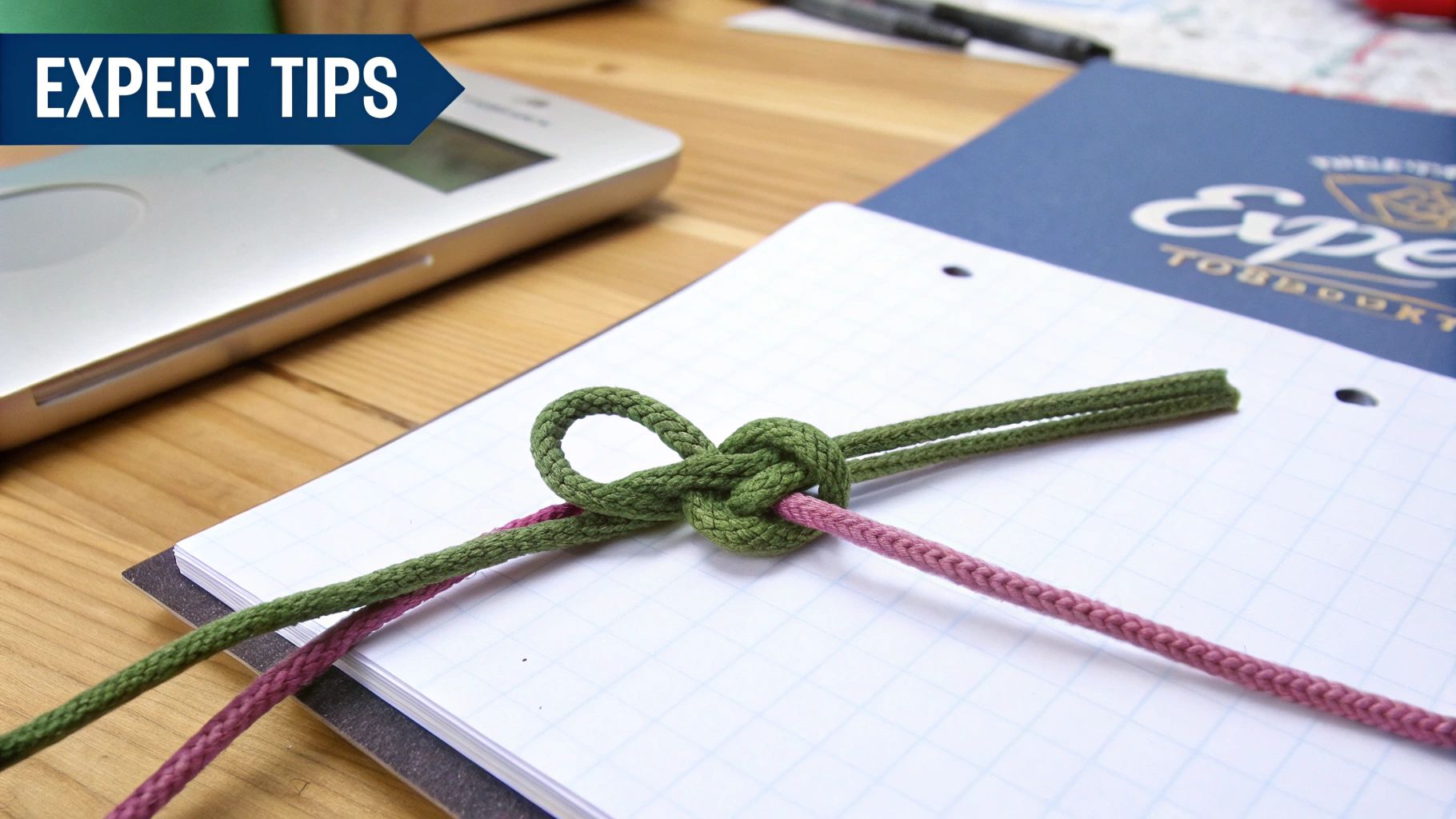
So, you've got the basic moves down. But why all the fuss over one little knot? It's easy to think of the slip knot as just a way to get the yarn on your hook, but from an experienced crafter's perspective, it's so much more. Think of it as the cornerstone of your entire project.
The way you tension this very first loop sets the stage for everything that follows. If your knot is too tight, you’ll struggle to make your first chain stitch. Too loose, and the start of your work will look sloppy or flared out. Getting it just right is what allows you to create a foundation chain with beautiful, even tension.
Setting the Stage for Success
That initial consistency makes a huge difference. A neat beginning leads directly to more uniform stitches in those crucial first few rows, giving your work a polished, professional look right from the start. Mastering this small step is the first real leap toward making crochet you can be proud of.
It also helps to know there isn't just one type of slip knot. Most of the time, you'll be using an adjustable knot, which is perfect for projects worked in the round like amigurumi or hats. That's because it lets you pull the starting hole completely closed for a seamless finish.
Learning how to create a slip knot for crochet isn't just a mechanical step. It’s the first moment of intention where you begin to shape the final outcome of your project.
Common Slip Knot Questions Answered
Even a simple knot can bring up a few questions. Don't worry, these are things every single one of us has wondered about at some point! Let's clear up a few common beginner hiccups.
Why Does My Slip Knot Keep Coming Undone?
This is a classic beginner moment, and the fix is usually very simple. It almost always happens because you’re pulling the short "tail" end of the yarn instead of the "working" yarn, the strand that’s attached to the ball.
Remember, a true slip knot should only tighten when you pull that working yarn. If it completely unties when you tug it, you’ve probably made a simple overhand knot by mistake. The best thing to do is take a breath, undo it, and mindfully try one of the looping methods again.
How Tight Should the Slip Knot Be?
Think "snug but not strangled." Your slip knot should be tight enough to stay put, but loose enough that it can slide easily up and down your hook’s shaft with a gentle push. This is your very first lesson in tension!
Too Tight: If it’s squeezing the hook, you’ll struggle to make your first chain stitch.
Too Loose: If it’s floppy, your starting tension will be uneven, making the beginning of your project look a bit messy.
You’re aiming for a comfortable fit that doesn’t grip or pinch the hook.
A perfect slip knot feels secure but relaxed, setting a calm and consistent tone for the rest of your project. It's the foundation of good tension.
Does the Slip Knot Count as a Stitch?
This is a fantastic question that trips up a lot of new crocheters. The answer is a simple no.
The slip knot does not count as your first stitch in crochet. Its only job is to anchor the yarn to your hook so you can begin. Your actual first stitch is the very first chain you create after the slip knot is on your hook.
You've just taken the first, most important step on your creative journey. By practicing how to create a slip knot for crochet, you are building the foundation for countless moments of joy and connection. Be proud of what you've learned today, and carry that confidence into your next stitch.
![The Ultimate Beginner's Guide to Crochet [2026]](http://crochetree.com/cdn/shop/articles/feat-ultimate-beginners-guide-to-crochet_eae81cec-84d0-455d-b190-08cd22d826c4.jpg?v=1777713815&width=700)
