Crochet starts as curiosity.
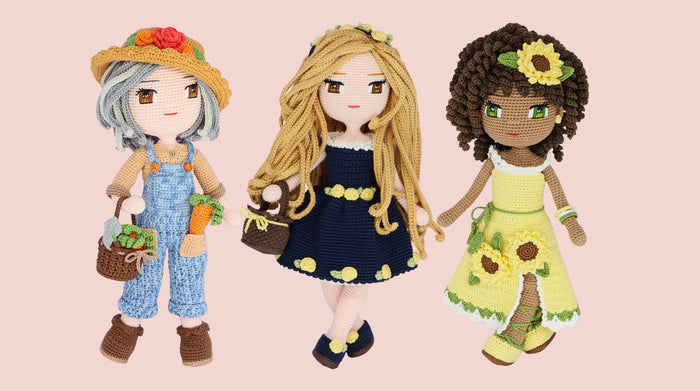
Maybe you saw a handmade doll that stopped you mid-scroll. Maybe someone in your family crocheted and you always wondered how those loops became something real. Or maybe you just wanted to make something with your hands... something slow, something yours.
Whatever brought you here, the thing nobody tells you at the beginning is this: crochet doesn't stay the same skill. It changes shape as you do. What starts as learning to follow instructions quietly becomes something much bigger — a way of thinking, a source of calm, and eventually, a part of who you are.
This is about what happens when you keep going. Not just through one project or one season, but across years. Because crochet as a lifelong skill looks very different from crochet as a hobby you tried once.
The Beginning: Learning to Follow
Every crocheter starts in the same place: counting chains, watching the same tutorial three times, and wondering why their edges look wonky. And that's exactly how it should be.
In the beginning, crochet is about learning to follow instructions precisely. You're building a foundation — not just of stitches, but of trust in the process. Chain 20. Single crochet across. Turn. Repeat. It feels mechanical, and sometimes frustrating, but every row is training your hands to do what your brain is still figuring out.
This stage teaches you something that extends far beyond yarn: the ability to start before you fully understand where you're going. You don't need to see the finished doll to make the first magic ring. You just need to trust the next step.
If you're in this stage right now, our Crochet Basics Beginner Course walks you through everything from your first slip knot to your first finished piece — at your own pace, with no pressure.

The Middle Stage: Learning to Adjust
This is the stage most people don't talk about, but it's where the real transformation happens. You've finished a few projects. You can follow a pattern without re-reading every line. And now you start noticing things.
Your tension is tighter than the pattern assumes. The head of your amigurumi looks slightly oval instead of round. A color combination that looked great in the photo feels wrong in your yarn. These aren't failures — they're the first signs that you're developing crochet judgment.
The middle stage is when you stop following blindly and start adjusting. You learn that patterns are guides, not gospel. Here's how your approach shifts:
| Early Stage | Middle Stage |
|---|---|
| Follow pattern stitch-for-stitch | Adjust stitch count based on your tension |
| Use exact yarn and hook recommended | Substitute yarns confidently and adjust hook size |
| Start over when something looks wrong | Fix mistakes a few rows back without frogging everything |
| Stick to one stitch type per project | Combine stitches for texture and shaping |
| Count every single stitch | Feel when a row is right by weight and shape |
| Nervous about trying new techniques | Excited to experiment — "I'll just swatch it first" |
This is also when your learning crochet journey starts to feel personal. Two people can follow the same pattern and produce noticeably different pieces — not because one is better, but because each person's hands tell a slightly different story.

When Crochet Becomes Yours
There's a moment, and you might not notice it when it happens, when you stop thinking of yourself as someone who does crochet and start thinking of yourself as someone who crochets. It's a subtle shift, but it changes everything.
This is when personal style emerges. You develop preferences that go beyond "I like blue." You gravitate toward certain stitch textures. You have opinions about yarn weight. You know, without checking a chart, which hook feels right in your hand for a given project.
Your crochet confidence shows up in small ways:
- You modify patterns without anxiety, adding a row here, changing a color there
- You can look at a finished piece and roughly reverse-engineer how it was made
- You start designing small things, a flower, a simple accessory, a variation on a doll outfit
- You buy yarn because it "feels like a summer cardigan" before you've even chosen a pattern
This isn't mastery in the traditional sense. It's something better: fluency. The craft speaks to you now, and you speak back.
If you're looking for projects that grow with you, from beginner-friendly to beautifully detailed — browse our full pattern collection. There's something for every stage of your journey.
Crochet Teaches Patience That Sticks
We live in a world that rewards speed. Fast answers, fast results, fast everything. Crochet is the opposite, and that's exactly why it matters.
When you crochet, you practice patience in the most literal way possible. You make one stitch. Then another. Then another. A doll might take 15 hours. A blanket might take months. And there is no shortcut. No way to skip ahead. The only way to the finished piece is through every single stitch.
What's remarkable is that this patience transfers. Crocheters often describe becoming more patient in other areas of their lives, more willing to sit with discomfort, more comfortable with slow progress, less rattled when something takes longer than expected. The benefits of crocheting long term extend well beyond the craft itself.
Research backs this up. Repetitive handcraft activities like crochet activate the same neural pathways as meditation, reducing cortisol levels and promoting a state of calm focus. But unlike meditation, you end up with a scarf. 💛

Projects Become Markers of Time
Ask any long-time crocheter about a specific piece, and they won't just tell you about the yarn or the pattern. They'll tell you when they made it.
"I made that blanket the winter my daughter was born." "Those were the first amigurumi I finished after my surgery." "I crocheted that scarf on the train every morning for two months."
Over the years, your finished projects become a quiet autobiography. Each one holds a season, a mood, a version of you. The early pieces, a bit uneven, a bit tight, remind you how far you've come. The ambitious ones remind you what you're capable of when you commit.
This is one of the most beautiful things about treating crochet as a lifelong skill. You're not just making objects. You're making a record of your own growth.
Some crocheters keep a project journal. Others let the pieces speak for themselves. Either way, there's something grounding about being able to hold in your hands the physical evidence of hundreds of hours of quiet, focused making.
Teaching Becomes Part of the Skill
At some point, someone will ask you to teach them. A friend. A child. A coworker who saw you crocheting during lunch. And when that happens, you'll discover something unexpected: teaching deepens your own understanding.
When you teach a beginner to chain, you have to slow down and articulate things you've been doing on autopilot. Why do we yarn over this way? What does "working into the back loop" actually mean? How do you know when your tension is right? Answering these questions forces you to examine your own knowledge, and often reveals layers you didn't know were there.
Teaching also connects you to the long chain (pun intended) of makers who came before you. Someone taught the person who taught you. Patterns get passed down, modified, personalized, and passed on again. When you teach someone to crochet, you're not just sharing a technique, you're continuing a tradition that stretches back generations.

Making Without Needing a Reason
In the early stages, every project has a purpose. You're making a gift. You're practicing a new stitch. You're following a pattern to prove you can.
But as crochet becomes a lifelong companion, something shifts. You start making things just because. Not for a gift, not for a deadline, not for social media. Just because your hands want to move, and the yarn is there, and the rhythm feels good.
This is crochet at its most honest. No productivity metrics. No outcome. Just the simple, radical act of making something with your hands because it brings you joy. In a culture obsessed with optimization and output, making without needing a reason is quietly revolutionary.
Keep a basket of beautiful yarn within reach. You'll be surprised how often your hands find their way to it — during a phone call, while watching a movie, in the quiet minutes before bed. That's not wasted time. That's the practice working exactly as it should.
Crochet and Self-Trust
Here's the thing about sticking with a craft for years: it builds a very specific kind of confidence. Not the loud, showy kind... the quiet kind. The kind that says, "I've done hard things before. I can figure this out."
Every crocheter has a story about a project that felt impossible at the start. A complex doll with dozens of tiny pieces. A lace shawl with a 12-row repeat. A garment that required actual math. And every crocheter who finished that project walked away with something more valuable than the finished object: proof that they can do hard things.
This accumulates. Over the years, you build a deep well of evidence that you're capable, patient, and resourceful. You've solved hundreds of small problems, a pattern that didn't make sense, a stitch that kept twisting, a color that wasn't working. Each solution, no matter how small, deposits a little more trust in yourself.
Crochet confidence isn't about being perfect. It's about knowing that you can sit with confusion, work through frustration, and come out the other side with something beautiful. And that kind of self-trust? It shows up everywhere, not just at your craft table.

What Changes When You Keep Making
If you're just starting out, everything in this post is ahead of you, and that's something to look forward to, not something to rush toward. 🌷
If you've been crocheting for years, you probably recognize yourself in these stages. Maybe you smiled at the memory of your first wonky chain or felt a quiet pride in how far your hands have come.
Either way, here's what we know for certain: crochet rewards the people who keep showing up. Not the fastest learners. Not the most talented. Just the ones who keep making — stitch by stitch, project by project, year by year.
And if you ever need a nudge, a new pattern to try, or yarn that makes your hands happy, we're here. Because at Crochetree, we believe something simple and true: You can craft this. 💛
Frequently Asked Questions
Is crochet a good lifelong hobby?
Absolutely. Crochet grows with you — from learning basic stitches to designing your own patterns, adjusting sizes freehand, and even teaching others. It builds patience, creativity, and fine motor skills that stay sharp for decades. Many crocheters say the craft becomes more rewarding the longer they practice, not less.
How long does it take to get confident at crochet?
Most people feel comfortable with basic stitches within a few weeks. Real confidence, the kind where you can adjust patterns, fix mistakes mid-row, and improvise, usually comes after 6 to 12 months of regular practice. Our beginner course is designed to get you through that early learning curve as smoothly as possible.
What are the long-term benefits of crocheting?
The benefits of crocheting long term include improved patience and focus, reduced stress and anxiety, better fine motor dexterity (especially important as you age), and a creative outlet that produces tangible results. Many experienced crocheters also find deep satisfaction in teaching others and connecting with a global community of makers.
Can I learn crochet at any age?
Yes — crochet has no age limit. Children as young as 5 or 6 can learn basic chains, and people well into their 80s and 90s continue to crochet actively. The craft adapts to your ability level, and ergonomic hooks and lightweight yarns make it accessible for people with limited hand mobility.
How do I go from following patterns to designing my own projects?
It happens gradually. Start by making small modifications to existing patterns — changing colors, swapping stitch types, or adjusting sizes. Over time, you'll develop an intuition for how yarn and stitches behave. Many designers say their first original piece was really just a combination of techniques they'd learned from dozens of other patterns.