
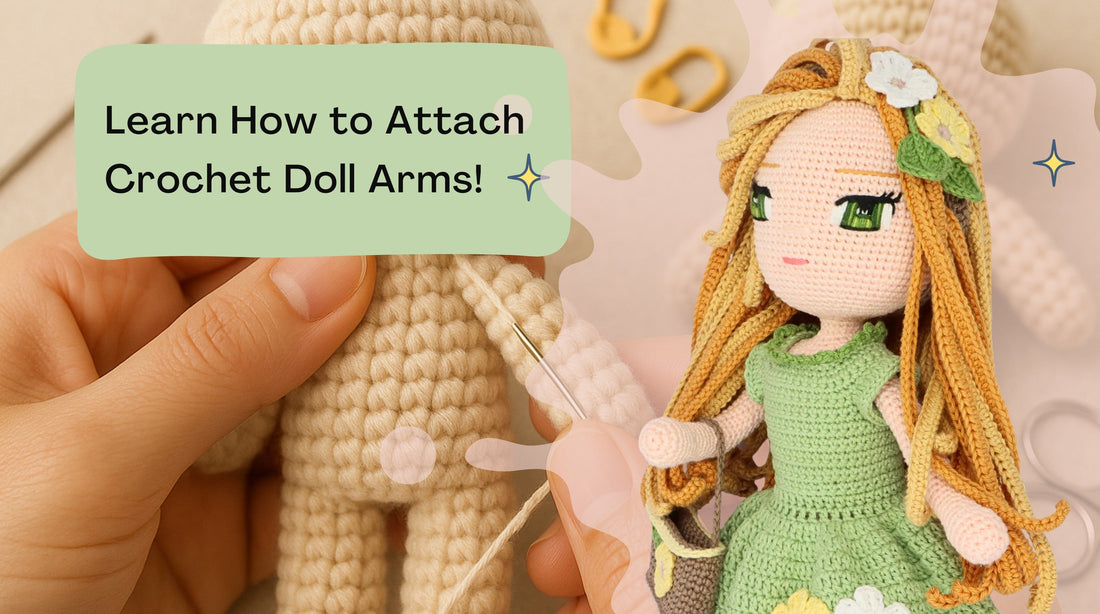
Bringing Your Crochet Doll to Life
You’ve finished crocheting the doll’s head, body, and arms. And now comes the moment of truth: assembly. Attaching arms might seem like a small detail, but it’s often what makes your creation look alive. When the arms sit at the right height and angle, your doll feels balanced, natural, and ready for hugs.
Many crocheters say this step feels intimidating at first. After all, no one wants their carefully made doll to look uneven or stiff. But here’s the good news: once you understand the placement and rhythm, it becomes one of the most satisfying finishing touches in amigurumi.
Why Arm Placement Matters
Think of your doll’s arms as its gesture. Arms that are too low can make a doll seem droopy, while arms that are too high can look unnatural or tight. Correct positioning helps:
|
Common Position |
Visual Effect |
|
Too low (below waist) |
Looks slouched or unbalanced |
|
Too high (near neck) |
Feels tense or stiff |
|
Slightly below neckline |
Natural, relaxed, friendly look |
Crochet art is all about personality, and symmetry is what gives that personality a sense of calm.
What You’ll Need
|
Item |
Purpose |
|
Yarn needle |
For sewing arms evenly |
|
Matching yarn |
Same color as body or arm |
|
Stitch markers or pins |
To mark arm placement |
|
Stuffing (optional) |
Keeps arms firm and plush |
|
Your finished doll body & arms |
Ready to assemble! |
(Tip: Work in good light so you can clearly count stitches and check symmetry.)
Step-by-Step: Attaching Crochet Doll Arms
Step 1: Position and Pin
For the Crochetree dolls, always check the pattern to make sure you stop at the correct round to sew the arms. For dolls in which you will sew the arms after finishing the body, place both arms against the body, just below the neckline. The top of the arm should align roughly with the top of the head.
Use pins or stitch markers to hold them temporarily in place.
💡 Pro tip: Stand the doll upright and look at it from the front and back. This helps you spot small asymmetries before you start sewing.
Step 2: Count for Symmetry
Count the stitches between the two arms on the front of the body.
For example, if there are 15 stitches between the left and right arm on the front side, make sure it’s also 15 at the back.
This ensures both arms are level and evenly spaced.
Crochetree tip: Small differences (1 stitch) can already make a visible tilt, so it’s worth double-checking here.
Step 3: Sew Using the Whip Stitch
Thread your yarn needle with a strand of matching yarn (around 30 cm long).
Starting at the back of one arm, insert the needle through the arm and then through a stitch on the body.
Pull the yarn snugly, not too tight, and continue this motion around the top of the arm.
Repeat until you’ve attached the entire top curve of the arm to the body.
(Imagine your stitches forming a little smile that hugs the arm into the torso.)
Step 4: Secure the Ends
Once the arm feels secure, weave in the tail inside the body to hide it.
Repeat on the other side.
If your doll’s fabric is thick, you can secure each arm with a second round of hidden stitches. This keeps them extra sturdy for kids’ play or frequent posing.
Step 5: Test the Movement
Gently move each arm up and down.
It should pivot slightly but not dangle. If one side feels looser, add a reinforcing stitch from the arm into the nearest body stitch.
💛 The “hug test”: Hold your doll under the arms and lift gently. If the arms stay firm, it’s ready to love.
Bonus: Attaching Arms with Thread Joints (Optional Advanced Technique)
If you’d like your doll’s arms to move freely (for posing or photography), try this simple “thread joint” method:
|
Step |
What to Do |
Why It Helps |
|
1 |
Thread a long strand through both arms and the body |
Connects arms symmetrically |
|
2 |
Pull both ends tight and tie inside the second arm |
Creates a movable joint |
|
3 |
Secure ends and hide inside |
Keeps it neat and invisible |
This method works beautifully for collectible dolls or those you’d like to pose sitting or waving.
Common Mistakes to Avoid
|
Mistake |
Result |
How to Fix |
|
Arms uneven |
Doll looks tilted |
Recount stitches before sewing |
|
Arms too close to front |
Feels flat or stiff |
Move placement slightly backward |
|
Sewing too tightly |
Shoulder dents inward |
Loosen tension and re-adjust |
|
Stuffing in way |
Lumpy join |
Flatten the top of the arm slightly before sewing |
Emotional Note for Makers 🌷
The final assembly is where your doll’s story begins.
There’s something poetic about it. This moment when you give your creation arms to hold and to hug. It’s the transformation from a pile of yarn into a character with personality, ready to bring comfort and smiles.
So take your time. Breathe. Straighten the arms, smooth the stitches, and feel that quiet pride that comes from making something with care.
Want to see exactly how we do it? Follow along with the Daisy Base Doll Course, where this technique is demonstrated step-by-step with close-up video guidance and helpful visual markers.


